Last weekend, I made my first skins using Rubber on the Run kits for the table, chute mat, and chute rim. Here are some of the things I learned during this phase. This is the third installment in my saga. I’m assuming that you have a copy of the book (“Making Rubber Skins for Agility Equipment“) or it won’t make much sense.
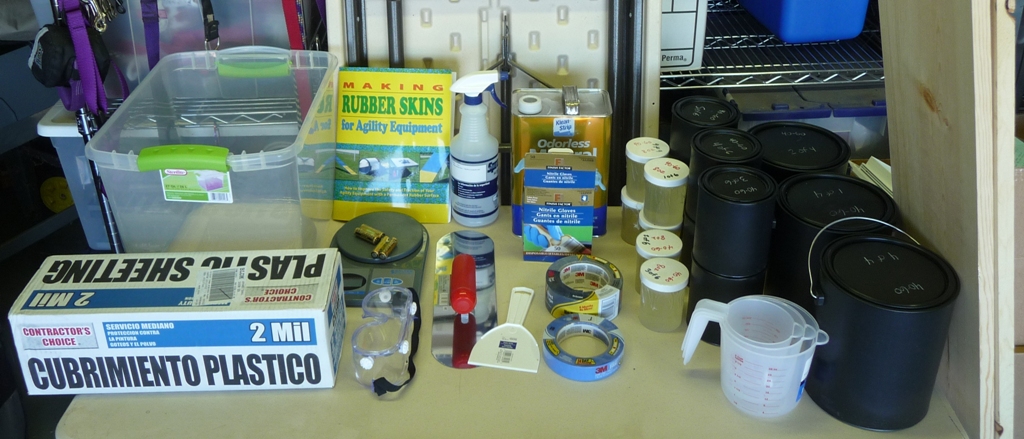
Supplemental list – things you need that I didn’t see mentioned in the book
- Big T- or L-square. This makes it much easier to lay out the tape patterns.
- Long straight-edge. Ditto
- Scissors. Easier than a utility knife for cutting the plastic. Actually, if you have a cutting board/wheel in your sewing room, that works even better.
- Sharpie. Required for marking corners on the floor and marking the plastic for cutting.
- Regular plastic spoons. I didn’t buy the suggested ice tea spoons because they are for mixing binder with acetone and the pieces I was making didn’t require that. I didn’t think about the scraping I’d be doing to transfer the binder into the rubber. I grabbed some plastic spoons out of my trailer – worked perfectly.
Preparation
- Despite your best efforts, rubber will get everywhere. Have a shop-vac standing by. It also helps when leaves and other debris blow in the garage door – stuff is attracted to the binder, much like a moth to light.
- Binder will also get everywhere and it’s sticky and nasty. Wear old clothes, protect everything you can with plastic, and remember that rags full of mineral spirits are your friend.
- Don’t underestimate the number of gloves you will need. Each piece requires at least four. I used six or eight on the table top.
Lessons I learned the hard way
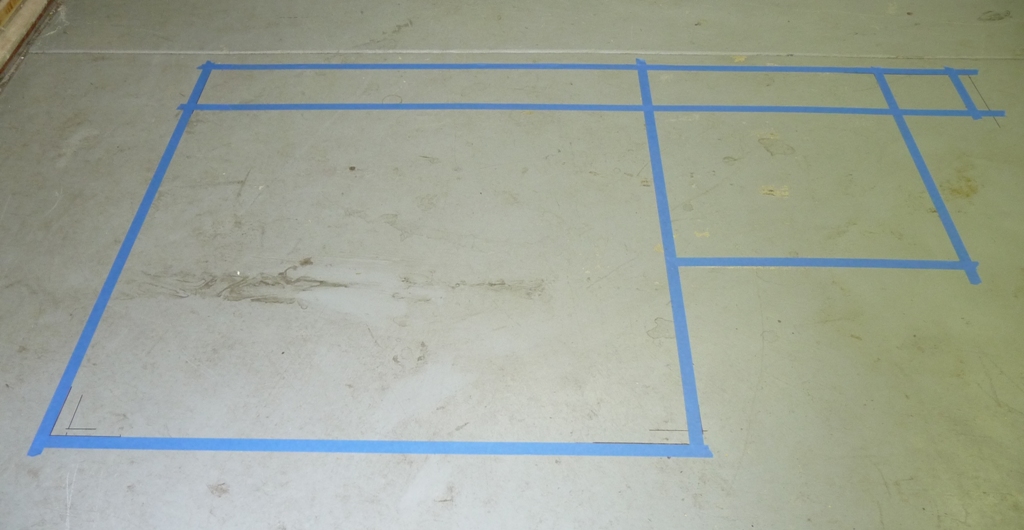
- The book reminds you to put the tape on the outside of your lines. Seems obvious, right? Double- or even triple-check your measurements after the tape is down. I just barely missed learning this one the hard way and had to reset some tape at the last minute.
- I thought a narrower and deeper 27-qt bin would be easier than a wider shallower bin for mixing the big batches (like the table). I was wrong. The deep bin has two problems: the depth of the mixture is greater than the length of the glove, and the deeper mixture also makes it more difficult to track down all of the dry pieces.
- The more pieces you plan to make in one session, the more room you will need to clear in your workspace for storing the pieces being cured. Misjudging this led directly to the next lesson…
- If you inadvertently screw up another skin that is curing nearby (by sitting on it like an idiot), you can “borrow” some goop from the skin you are working on to repair the damage.
Tips I learned along the way
- If you’re using a gallon can of binder, don’t try to pour it – use a 1-cup plastic container to transfer it to your weighing container.
- Do the best you can, but accept that you will lose a little rubber and binder on each transfer. No need to get compulsive, there is plenty of goop and you don’t want to lose valuable time. In fact, I learned the next day that it’s easier to clean up if you don’t try to scrape the bin completely clean.
- The pellets get significantly darker when they are coated with the binder. This makes it easy to tell when you are done mixing – when you no longer see any lighter pellets.
- You really need to scrape every nook and cranny of the bin when you are mixing up the goop to be sure that you don’t leave any dry pellets or pockets of binder behind.
- The book suggests a 1-1/2″ or 2″ putty knife. I also suggest a 4″ one for the big pieces. I found both 2″ and 4″ disposable plastic putty knives for $0.84 at Lowes.
Clean-up
- I was skeptical about the claim that the binder would peel off of plastic. It actually does, but you have to wait the full 24 hours, and even more if it is thick like the goo at the bottom of the measuring container.
- On the flip side, the binder sticks to everything else. If you don’t promptly clean up everything that is non-plastic (metal, concrete, paint, wood) with mineral spirits, you’ll be needing that metal putty knife after all.
- I woke up Monday morning with a thin sheen of binder on my hands. I hadn’t noticed it over the weekend, but when I washed my hair, it felt like my hands were coated with silicone. Now it’s peeling and looks like a horrible disease. I’ll try some more mineral spirits, but that has its own side effects on the skin. Just be ready for that.
Things I’m still trying to figure out
- I’m not at all sure how to tell if the mixture is evenly distributed and uniformly thick. I’m guessing it involves one person lying on their side eyeballing the sheet and guiding the troweler to the hot spots.
- My first effort was with a two-toned blue/yellow mix. If I had it to do over, I would start with a solid color. I think it will be easier to gauge thickness and even distribution with a solid color because the floor showing through will give a much clearer contrast.
- I found that the 1″x10″ boards got in the way. I’m thinking about alternatives, including shorter pieces, weights or some other way to secure them, and maybe even 1″x2″ half-frames instead (with just two sides and a corner). That idea might actually have merit because it could double as the straight-edge and corner angle for laying out the tape. Hmmm, maybe I could make a jig out of two 48″ pieces of 1/2″x2″ nylon from TAP Plastic, mitered on the corner, and connected with a hinge on the outside of the joint…I’ll get back to you on that.
Keep in mind that these tips only got us through making the raw skins – I still have to trim them and glue them to the equipment. I’m sure that will generate another installment.
Next up: Gluing and Trimming


 Posted by agilepooch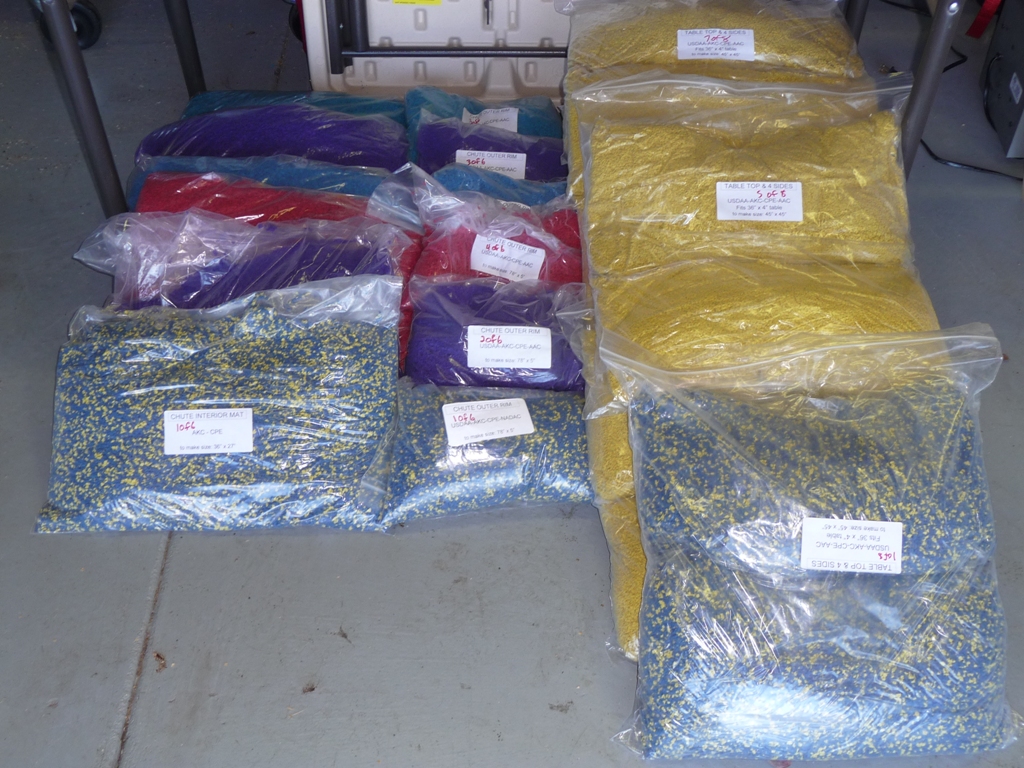


 AgilePooch Diaries