2011 Utah 1088, Part III: Results and Review

September 7, 2011

My 12-hour rally was over and I had met both of my goals – stay upright and healthy, and Finish. Furthermore, I had determined by the number of DNFs that I had somehow managed to land on the podium. I had a great time, followed by a good rest, so now it was time to enjoy the post-rally festivities. The full report of my 12-hour ride is here: 2011 Utah 1088, Part II: Rally Day!

The Return of the Real Rallyists

I got up at 5am and headed down to the parking lot to greet the real rallyists as they checked in to the finish line. These are the folks who entered the 24-hour and 3-day events, the hard-core long-distance enthusiasts on big custom-outfitted motorcycles. Most of them don’t even get warmed up and settled in the seat until long after 12 hours has passed. Some had arrived earlier in the morning and were already recovering in bed. Some had informed the RM that they would not be making it in on time for a variety of reasons – rest, mechanical failure, bad time or fuel management – but hoped to return in time for the banquet. Tragically, we also learned that one of the riders got tangled up with tornado winds in Nebraska and had ridden his last ride. That news definitely put a damper on the morning’s activities, but for the most part, the returning riders were upbeat and enthusiastic about their adventures. Rich made it in from his 3-day ride with about an hour to spare. Time to move on to rest, war stories, and the awards banquet.

Results

I’ll just come right out and say it – I won the Single Rider Class of the 12-hour Utah 1088 rally. I already knew I was on the podium because of the four DNFs, but I never dreamed I would be the winner. I somehow managed to ride 564.6 miles in 11 hours and 31 minutes on a 250cc motorcycle and earn 29,730 points.

Utah 1088 trophy – beautifully laser-etched by Steve Chalmers

Click these links for the complete results from the 3-day, 24-hour, and 12-hour divisions. Also, click here for a summary of the total miles for each rider.

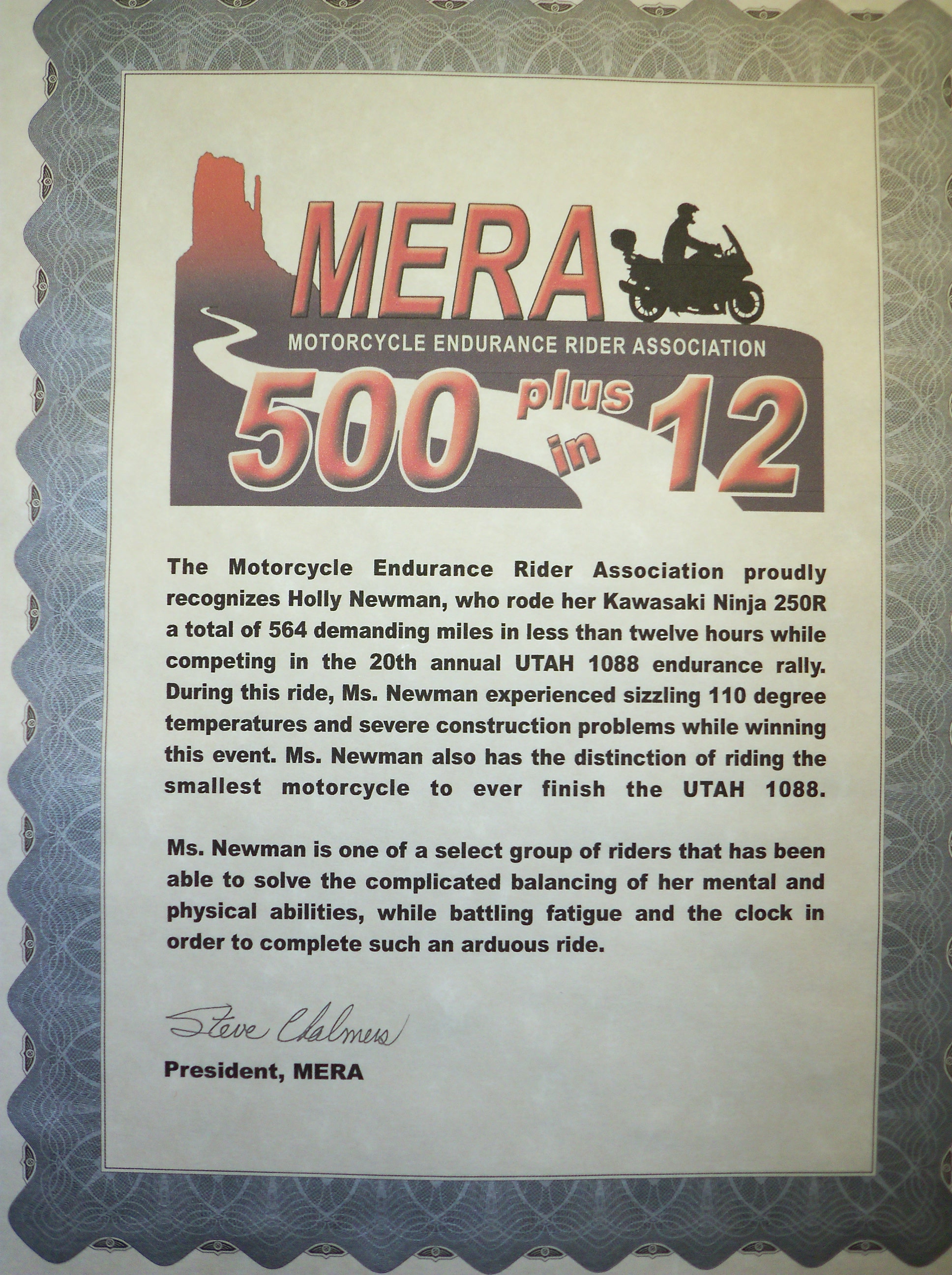
Oh, and one more thing: I earned a MERA Certificate for riding >500 miles in 12 hours! The cert showed up in the mail in August. This is one of the great personal touches that Steve puts on his rallies – it’s not just a generic certificate, it actually acknowledges details about MY ride!

Reflections on Preparation

Referring back to the articles I wrote on preparing for this event (which are linked in the headings), I want to highlight the improvements that I found most significant.

The Bike

The 250 Ninja is NOT a rally bike. Most of the riders who do these things are on big bikes – 1000cc and larger. In addition, many of them have been heavily modified with custom-made seats, extra fuel tanks, lights that turn night into day, and all manner of electronics. Though Rich and I made significant changes to my bike, what we did is nothing compared to what you see on the big bikes that the serious riders use. In fact, as I pointed out in that article, most of the changes we made were underway before I even decided to enter the rally. That said, I want to point out the two most important changes, without which I know I couldn’t have survived for 12 hours.

  1. Riding position. Changing from an aggressive sporty position to a more natural upright position was key. This was accomplished by raising the handlebars and seat and lowering the foot-pegs. The result was an amazingly comfortable riding position that sustained me until about an hour from the end, and then the only thing that gave up was my derriere.
  2. Throttle-lock. I have no doubt that I would have given up without a good throttle-lock. I used it for much of the ride, especially on the straight interstates and rural highways. On the twisty stretches where I couldn’t use it, my aching thumb and wrist quickly reminded me how bad the ride would have been without it.

The Body

I did make some changes to my gear that I wouldn’t have done had I not entered the rally. Some of the changes were due to personal experience during my shakedown rides, and others came from the wisdom of the community. The two most important changes I made to my gear were these:

  1. Flip-up Helmet. When I decided to buy this, I thought it would enable me to eat and drink as I rode. That is not the case, nor is it the true benefit. With the hydration tube and the retracting reel, I can drink without flipping it up. And the thought of eating on the fly turned out to be ridiculous – even if I had figured out a way to extract my jerky from the tank bag without crashing, I probably would have bitten holes in my cheeks. No, the value of the flip-up is that you can have meaningful and non-threatening interactions with humans (convenience store clerks, Checkpoint personnel, locals who know where the 3600-pt memorial is) with the helmet on. I knew from my limited shakedown experience that I wanted to avoid removing my helmet if possible – not only does it take time and have to resettle into position, but I also knew that if I allowed myself to feel the relief from the sweating and itching, it would be doubly annoying to have it return.
  2. Ear Plugs. I had no previous experience using ear plugs while riding, but on the advice of seasoned rallyists I decided to try them out. I first rode with them on Shakedown ride #3 to get used to the feeling and difference in the sounds around me. And then on the way home from that ride, I forgot to put them in. It took me about 30 minutes to realize my mistake. What a difference – it felt like all 250cc of the bike was in my head. And on this rally with the higher speeds and RPM, I would have been miserable without them! Thanks to PlugUp for a great product.

The Process

Even though I have never ridden in a rally before, I have been intimately involved with these events for nearly 20 years because of Rich’s participation. I acknowledge that I’m a dilettante, but I have paid close attention to his learning process (both successes and failures) in all aspects of rallying – preparing the bike, managing gear and paperwork during the ride, pacing, and routing. In other words, by pure osmosis I was perhaps one of the best-prepared rookies ever to enter a rally and I was rewarded for the effort.

As I reflect on my shakedown rides, my pre-rally planning, and the execution of my plan, I can see a few opportunities for improvement but I can’t identify any significant mistakes. That’s one of the reasons I went to the trouble to write all of this up – I’m more than willing to share my experiences with other rookies. Looking forward to next year, the only thing I would change in my strategy is to soften my “off-the-bike” and “wrong-direction” avoidance rules and go for one or two of the “in-town” Boni if they seem doable.

What’s Next?

Will I do it again?

When I first entered the rally, my plan was to do it once to shake the dilettante monkey off my back and then quietly slide back into my supporting role for Rich. But I had a blast and I want to do it again. I have already told Steve that I will keep entering the Utah 1088 as long as he continues to offer the 12-hour version.

What about longer rallies?

Not going to happen, not a chance. I’m not comfortable on big bikes, I’m nervous riding at night, and I’ve never been worth a damn on graveyard shifts or any other sort of all-nighter. I have neither the skills to ride fast nor the desire to ride far. And I have no interest in doing any hard-core customization on the Ninjette, like adding fuel capacity or lights.

Will the field be larger next year?

2011 was the first year that Steve has offered anything other than a 24-hour version of the Utah 1088. But both the 12-hour and the 3-day versions were well-received and he has decided to use the same format next year. My hope is that reports like this will draw more riders to the 12-hour rally – it is a perfect place for rookies who want to give it a try and veteran rallyists who are ready to scale back from the longer rides. In fact, I’m toying with some ideas for additional incentives to riders who enter on small bikes like mine – sort of a Baby Bike Challenge.

So with all that said, it’s time to sign up for 2012! The 2012 Utah 1088 Entry Form is now available and I encourage my riding friends to give it a try.

And yes, I entered it and ran it. Here’s that story: 2012 Utah 1088, Part 1: What? Am I really doing this again?


2011 Utah 1088, Part II: Rally Day!

September 7, 2011

The bike is perfect (Farkles for the Ninjette), my gear is ready (Body Farkles: Damn, 12 Hours is a Long Time), I am prepared (Shakedown Rides: Training for a 12 Hour Rally), and my route is plotted (2011 Utah 1088, Part I: Final Preparations). All that’s left to do is run the rally.

The Start!

At 7:00am, I was ready for the symbolic green flag (actually the RM’s hand) to drop. I let the gung-ho gun-slinger crowd go ahead so I wouldn’t get caught up in a melee exciting the parking lot. As anticipated, I was the one of the few that went West onto the freeway because most of the riders either went East to the BMW shop or South to the shooting bonus, both of which I had decided to skip.

Three Rally Lessons Learned

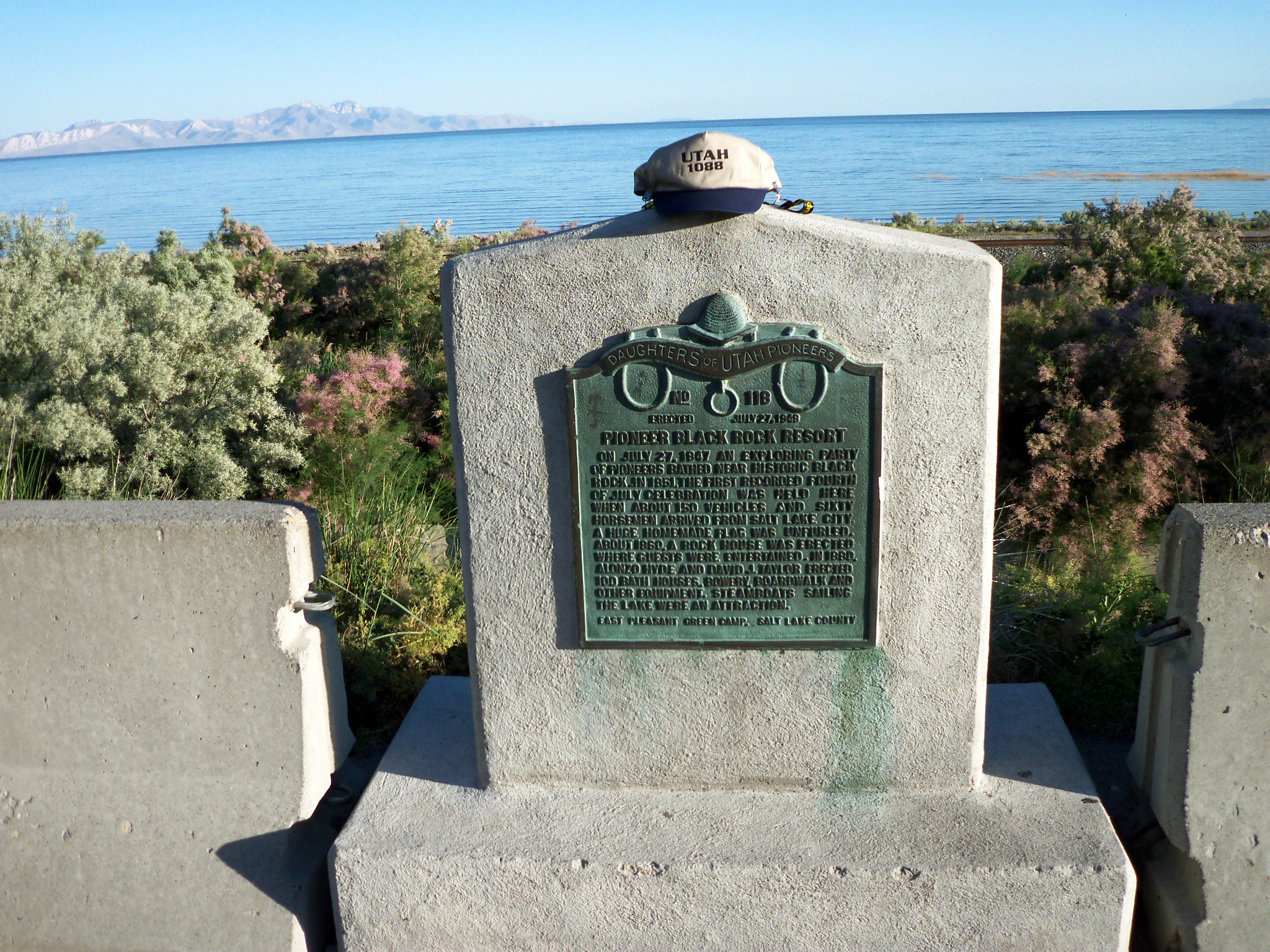
First stop was a Vista Point with a couple of plaques on I-80 overlooking the Great Salt Lake. On this bonus, I learned Rally Lesson #1: Never Trust Your GPS. When a location is described on the instructions as “between MP# and MP(#+1)”, there’s no way to accurately represent it on a computer map while setting up the routing. As a result, I visually identified my target at the exact moment that I blew by the exit.

I wasted no time learning Rally Lesson #2: Do Whatever It Takes To Get The Points. I spent about a nanosecond on the shoulder determining if I could cut across the dirt divider to get there (no, there was a cyclone fence), and then headed to the re-entry on-ramp. Because I am (or was) generally a law-abiding motorist, I spent another nanosecond wondering if I should park at the exit and walk back. You can guess the rest – yes, I rode the wrong way back up the on-ramp to get where I needed to be. Funny how much easier those decisions got after the first one – it’s definitely a slippery slope.

At that point, I learned Rally Lesson #3: This Is A Competition. I knew several things about this bonus: (1) it asked a question that required an answer; (2) the answer sheet was not consistent and suggested that a photo was required; (3) all photos had to include our rally hat; and (4) where there is ambiguity, more information is better. There were two other riders there and they had just taken a picture of the marker . . . without their hats. Before I could stop myself, my Outside Voice said “I don’t think a picture is enough”. CRAP, Shut Up You Idiot. As they went back to review their paperwork, I wrote down the answer to the question and hustled to take a photo with my hat before they noticed their other omission (the hat). Lesson learned, move on.

Salt Lake Vista Point, 998 pts

This isn’t as hard as I expected

I was back on my way with an easy 998 points under my belt. Next stop, get the name of a “geological feature” on SR-196. I already knew it was called Lone Rock because it said so on Google maps. But I still had to record my time and mileage when I got there (a requirement of all bonus stops). Chalk up another 999 points – I was on a roll and was really starting to enjoy the ride.

Another lesson I was also learning quickly is that it’s a lot easier to average 60+ mph in western Utah than it is in western California. Not only are the roads straight (in contrast to the California coast), but the posted speed limits are much more liberal: 2-lane rural highways are 65mph, the interstates are 75mph, and we all know that those are just suggestions. As I flew south on SR-196, Carmen (my GPS) reported my estimated arrival time at the CP as 10:13, more than 45 minutes ahead of opening time. Great start! Then came the next bonus search when everything changed and I began the traditional “swearing at the Rally-Bastard” ritual.

Rally-Bastard, you have earned your nickname

The next stop on my route was a huge 3598-point GPS-only bonus – we were given coordinates and instructions to take a photo of a Memorial at N 40 32.307 W 112 44.834. I had mapped it and it appeared to be right on the highway, so I rode along looking for something obvious. I noticed a roadside shrine along the way, but that felt too random and temporary to be the intended target. I rode back and forth a few times trying to narrow it down (BTW, the Ninjette makes beautiful illegal u-turns on 2-lane rural highways – did I mention that slippery slope of legality?).

I finally ended up at a ramshackle roadside ranch, which according to Carmen looked pretty close – I figured I could wing it into position. I rode into the driveway and watched the coordinates get closer as I headed directly toward a horse corral. The immortal words of Joseph Smith crossed my mind: “This is [or must be] the place!” I walked around for a few minutes looking for something, anything – a hand-painted shingle in memory of Uncle Jake would have sufficed. Nothing. I took a photo of Carmen (showing N 40 32.289 W 112 44.832) to prove I had tried. I didn’t really think it would fly but I had nothing to lose. At this point, I also noticed that my CP arrival time was ticking away with alarming speed so it was time to get back on the road.
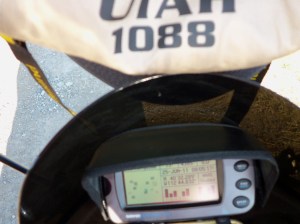
N 40 32.307 W 112 44.834 - any farther North and I'd have been in the horse corral

As I headed out of the ranch, I spotted a fellow in coveralls wrenching on a large tractor behind the barn. I rode over to him, flipped up my helmet to expose my gender (constrained by ATGATT), flashed a winning smile (constrained by properly-fitting cheek pads), and these words actually came out of my mouth (spoken with dimples in my voice): “Hi! I’m on a little scavenger hunt and I’m looking for a memorial somewhere in this area – can you help?” “Yes,” he said, “it’s across the road up the hill.” My heart sank. “Oh, so I have to hike up there?” [thereby breaking my “time off the bike” rule…] “No,” he said, “just go back up the road a mile or so and look for the turn-off.” My heart soared and off I went.

The turn-off, though marked with a government sign pointing to “Iosepa”, turned out to be a gravel road. I don’t have a lot of gravel experience (OK, none), but I reminded myself why I love this bike – it’s short and it’s light. I can hold it up at a 30-degree angle, I can pick it up if it falls over, and worst case, I could slip the clutch and paddle-foot up and back if need be. Carmen convinced me that I was still far enough ahead of schedule to the CP to give it a go and so I headed up the hill.

Nothing could have prepared me for what I encountered next. My first clue of strangeness was a colorful hand-painted sign at the entrance to the gravel road welcoming me with “Aloha Iosepa”. Hmmmm. I could see a tall monument in the distance so at least I knew I was on the right track. I rounded the bend and this is what I saw: on my right, a motley assortment of RVs and tents; straight-ahead, a huge clearing with a permanent awning and picnic tables crowded with lots of children, quite a few women, and not quite enough men; on my left, an old cemetery in which stood the previously-spotted monument.

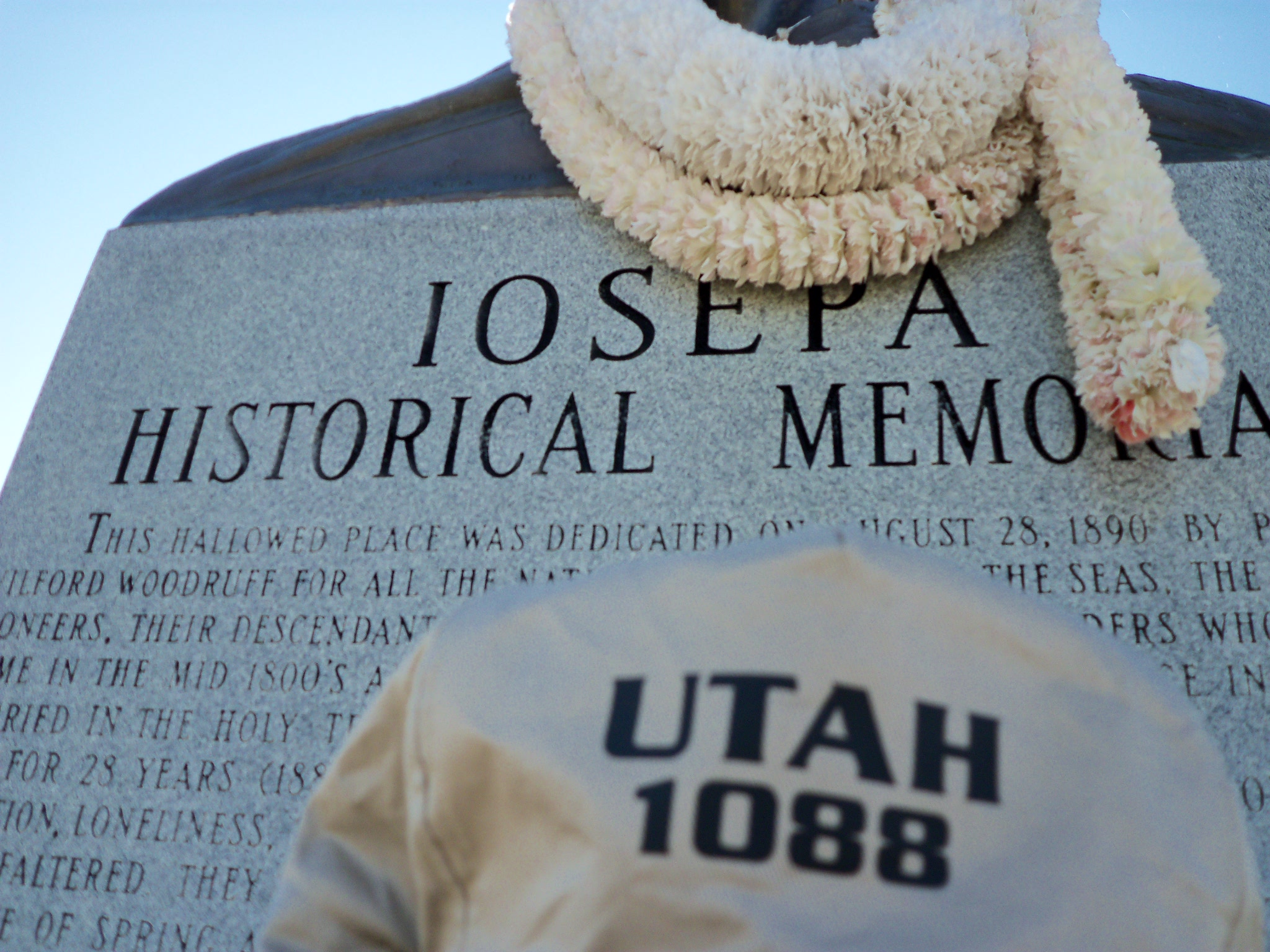
The monument turned out to be a huge engraved granite slab with the bust of some sort of warrior on top and what appeared to be a feather boa around its neck. At this point I didn’t really care – I was already WAY over-committed to this bonus and I just wanted to get my photo and get on down the road. There was a nice fellow at the memorial who, after I offered a few explanatory words, offered to hold my hat for the photo (that’s his arm on the right).

Iosepa Monument, 3598 points

I took an extra close-up because I figured no one would believe me about the feather boa and then headed out for the even more treacherous ride DOWN the gravel road. I arrived back at SR-196 feeling VERY smug and intrepid (not to mention 3598 points richer). I’m also not ashamed to admit that I was pleased that no other riders had seen me so my “intel” was secure – I earned those points and didn’t want to share! As I headed back on course, Carmen still reported arrival time at CP of 10:47am – 13 minutes before opening – WHEW!!!!

Iosepa Monument - is that really a feather boa?

As I wrote this, I decided to find out more about this Iosepa place. Its Wikipedia listing (complete with a photo of the monument) reveals that the accessory is in fact a lei, not a feather boa. It describes the site as a 19th-century settlement of Polynesian LDS church members. I feel compelled to point out that none of the people I saw there looked the slightest bit Polynesian, but I digress. FWIW, Wikipedia lists the coordinates as N 40 32.233 W 112 44.667, not N 40 32.307 W 112 44.834 – don’t know where the discrepancy came from but it doesn’t matter now – I got the points.

Things can change after the instructions are printed

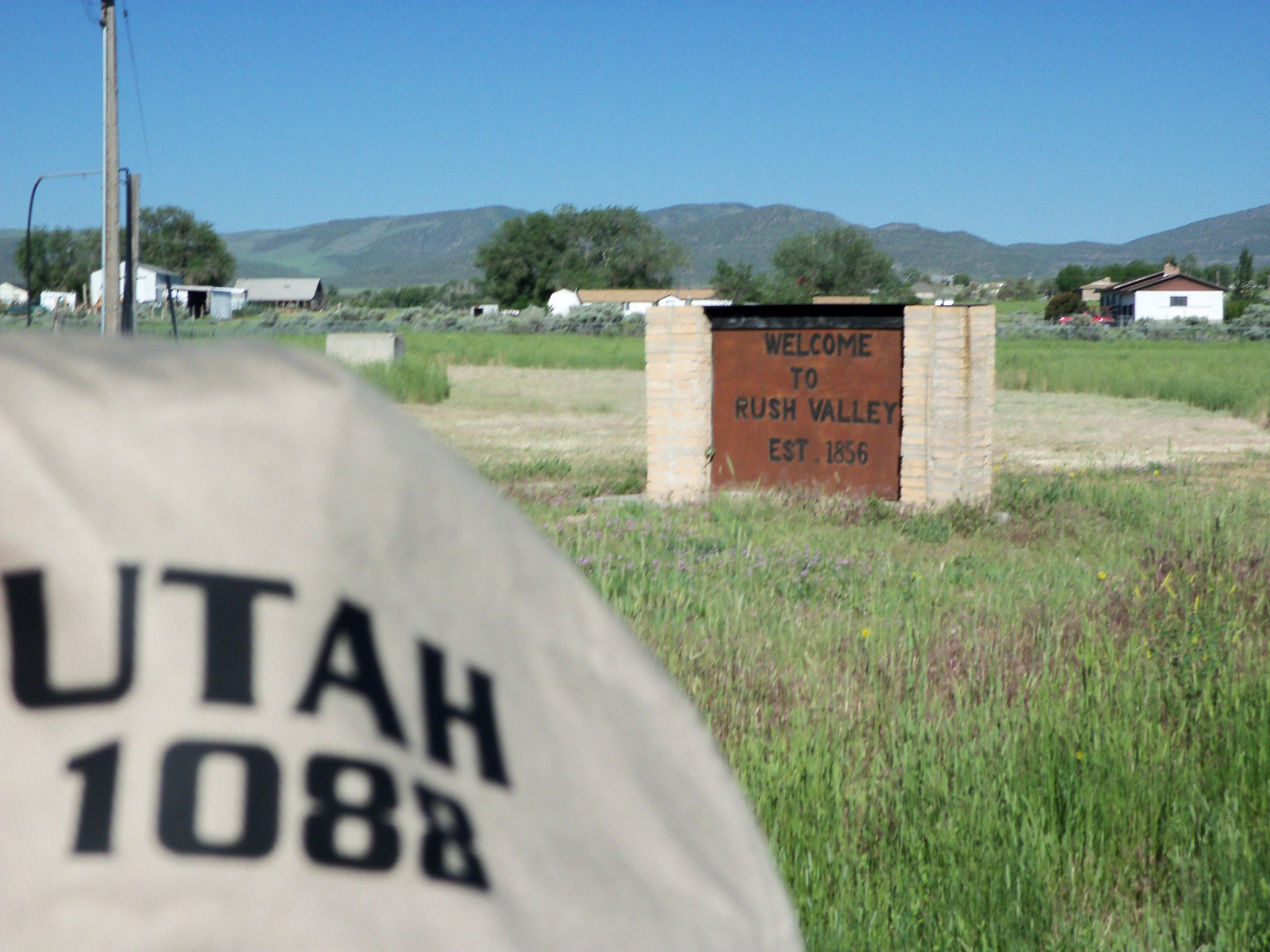
After marveling for a moment at a huge new building with no signage out in the middle of nowhere at the intersection of SR-196 and SR-199 (which I assume to be a new LDS church for the town of Dugway), I turned east on SR-199 and headed for the historic town of Rush Valley. Along the way, I found myself on a splendid mountain road over the Stansbury mountains. Slowed me down a little, but not as much as Carmen expected – I actually gained some time. My task was to find a rusty sign for Rush Valley, note the date the town was founded, and take a photo for good measure (865 pts). Easy peasy.

Historic Rush Valley sign, 865 pts

Then I headed west on SR-36 looking for the intersection with SR-6, at which I was instructed to find an odd collection of highway signs and arrows pointing every-which-way. Got there, no signs, several other motorcyclists riding back and forth looking perplexed. I did the same (rode back and forth), opted to write my time, mileage, and “no signs” on my paperwork, and then headed on down the route.

But a couple of miles later, my “get something to prove you were there” instincts kicked in and I realized I really should have a photo. I was still ahead of schedule for the CP, so back I went to take a photo of the sign for the abandoned smog inspection station in the area. I learned later that a truck had taken out the highway signs and some rallyists had submitted photos of the skid marks as proof – that’s pretty creative.

Proof that I at least tried to find the cluster of highway signs, 1156 pts

While I was taking my photo, another rallyist wandered over to chat. He asked if I had been able to find the GPS bonus. With my newly-jaded attitude borne from the Vista Point experience, I responded with an eye roll and “uh, yeah.” He pressed me, describing the horse corral, and wanted to know how I had found it. I responded with “It doesn’t really matter now, gotta go”, flipped my helmet down, and took off out of the driveway. Damn, I really am a bitch! (I later apologized to the rider back at the hotel and described the effort I had gone through to find the flippin’ Memorial…)

The All-Important Checkpoint

As I headed east on SR-6 toward I-15 (and the CP), two things became clear:

  1. Carmen assured me that in spite of my two significant delays, I was still going to get to the CP about 15 min early, BUT
  2. All that extra driving around for the two elusive Boni had seriously jeopardized my odds of making the CP without refueling

My pre-rally estimate of 200 miles per tank didn’t take into account the effects of sustained speeds of 80+ mph. My original route had shown a distance of about 175 miles to the CP, but with the back-and-forth of the memorial and the missing signs, I had added quite a few miles to my total. High on the list of rally no-no’s is running out of gas. And I instinctively knew that getting gas in a town before I launched onto the Interstate was bound to be less disruptive than having to exit the Interstate for gas before I arrived at the CP. So I filled up with 4.4 gal in the town of Santequin at 177 miles and then headed south on I-15 for the CP.

As I rode the last 22 miles into the CP at Nephi, I ran down my checklist of chores. It hadn’t occurred to me to anticipate and write them down (note to self: do that next time), so I counted them out on 7 fingers to help me remember:

  • Top off the gas tank (it took 0.4 gal – my tank holds 4.8 gal – good thing I stopped in Santequin!)
  • Refill the hydration bladder (I was determined to stay ahead of the water loss)
  • Suck down a bottle each of Gatorade and Boost (breakfast of champions)
  • Re-apply sunscreen and chapstick (yes, you can get a seriously ugly burn even with a helmet on)
  • Clean the bugs off the face shield (they ALL came from the first 30 miles on I-80)
  • Secure the flapping straps on my tank bag (you have no idea how annoying and distracting that is)
  • Pee (was that TMI?)

I pulled into the CP at 10:45am, 15 minutes before it opened, leaving me a precious 15 minutes “off the clock” to perform my checklist tasks. I remembered all but one (the flappy straps). At exactly 11:01am, I checked in with the RM, mentioned the missing signs (which he already knew about), and thanked him for inviting me to the picnic on the side of the hill with the fundamentalists. Then I headed out for the remaining 8 hours of the rally. Life was good!

Hundreds of miles and not much to do

I left the CP feeling relative relaxed. I was true to my plan, on schedule, and feeling really comfortable on the bike. The next few hundred miles didn’t pose too many challenges, or so I thought. I had a simple 987-pt Bonus as I headed east on USH-132 (the name of a Scenic Byway) and then no more “work” to do until I arrived in Duchesne.

30 minutes later, I hit the wall in the town of Mount Pleasant – it was starting to get hot and the country roads were long, straight, and hypnotic. I pulled over in the shade, walked around a little, and chugged my first ever 5-hr Energy Drink. Rejuvenated, I was content to follow a couple of RVs out of town and up the hill until I could find a safe place to pass them (it’s harder on a little bike, trust me…) and I finally made it to USH-6. Ah, the mountains, much cooler and more interesting. As I headed east on USH-6 toward Helper (a road that Rich and I have traveled dozens of times on the way to Colorado), Carmen reported that I would return to the hotel by about 5:00pm. Really? Two hours early? I started to second-guess my plan. Could I have done some of the “in-town” bonuses in the morning? Could I actually make it to Little America WY after all?

NO, NO, NO. Discipline kicked in – I must Finish – nothing more,and definitely nothing less. But at this point, I did allow myself the freedom to contribute a few entries to the newly-launched Utah 1088 Photo Blog, which we had been strongly encouraged to do as we went about our travels. Here is my first Photo Blog entry from Soldier Summit on USH-6.
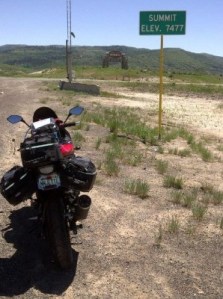
The Ninjette made it to Soldier Summit. Past the halfway pt and still going strong. Damn, it’s pretty out here!

Tar Snakes – Are You F***ing Kidding me?

Just when I thought I had nothing but a simple cruise to the next bonus in Duchesne, I encountered trouble coming out of Price Canyon – the dreaded tar snakes. I had heard about their evilness, but for some reason I thought that wetness was the problem. In fact, when I started up the hill and saw them, I remember thinking “good thing it isn’t raining.” The next thing I knew, both of my tires were sliding and I nearly crashed. It turns out that in the heat they turn into little strips of oiled Teflon. And because they aren’t flush with the pavement, the little bike gets “light” when it hits them, compounding the problem. Those few miles turned out to be by far the scariest of the day – and worth a Photo Blog entry so I never forget.
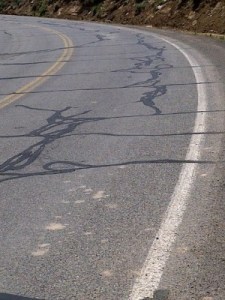
My first tar snakes ever. They SUCK!!! (Especially on a light bike…)

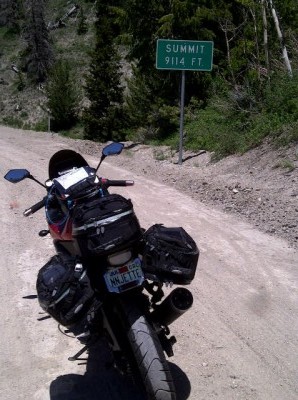
As I continued out of the canyon toward parts unknown, the tar snakes became a distant (and unpleasant) memory and I was actually starting to enjoy the twisty road. But then I experienced the first true deficit of the little bike when I realized that my throttle hand had hit the stop and my speed was dropping … 50.3 … 49.5 … 48.7 … 47.4.  …  wow, this must be a really steep road! Imagine my surprise when I emerged from the climb to discover a “Summit 9114 Ft” sign. I have since learned that this unlabeled summit is called “Indian Creek Pass”, but at the time, all I knew is that it was REALLY high! It was worth a couple of Photo Blog entries – a photo of the sign, a photo of the view, and a pee behind a tree (mercifully, no photo).

Holy crap – 9114 ft? No wonder the poor little thing was working so hard coming out of Price canyon!
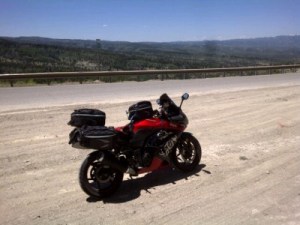
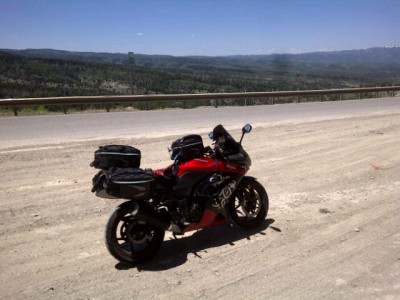
…And this is the pay-off for all that work – what a view!!!

The ride from Indian Creek Pass into Duchesne ranks among the best rides in my (admittedly limited) riding career. For you West Coasters, think Spooner Pass into Carson City but several times longer and no traffic. I stopped on my way into town for an 1136-pt photo of the Duchesne City Cemetery, a quick gas fill-up, and then West on I-40.

Duchesne City Cemetery, 1136 pts (yep, that's my hat between the E and the T)

Just when I thought I had it wired: Wind and Construction

On the map, I-40 looked like a cruise, but wind and construction demonstrated why my conservative strategy was sound. I was not terribly phased by the wind, but only because I had encountered it during one of my shakedown rides coming home from San Jose. Construction, on the other hand, is a giant PITA and there is no way around it.

Stop #8 on my route was a 1458-pt memorial cross on I-40, one of 14 throughout the state erected to memorialize fallen UHP troopers. (I have since learned that an atheist group has filed suit to have these torn down. Really? Can’t you find anything more important to do with your time and money? Like campaign against Rick Perry? Sheesh… I could barely see the cross, let alone be offended by it.) Meanwhile, back to the rally, this stop happened to be at a huge pullout, which inspired me to perform some much-needed housekeeping (hydration, nourishment, sunscreen).
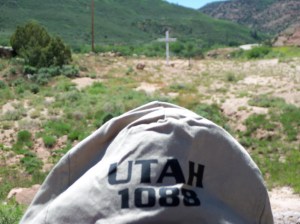
UHP Memorial Cross, 1458 pts

I headed on down the mountain into Heber City, topped off the fuel tank, then turned south onto USH-189 toward Provo. I found myself riding by Deer Creek Reservoir watching the kite-surfers – hey, I thought that was a SF Bay thing – who knew you could do that on a lake too!

As I continued down the western slope of the Wasatch, I executed a significant (and planned) modification to the Main Route instructions by blowing past the turnoff to SR-92, aka the Alpine Loop. My mapping software had fought me the night before when calculating the route, and when I zoomed in to find out why, the smooth line transformed into a very squiggly line. AND, there were no bonus points on that leg to lure me. While the road itself (which I hear is beautiful) might have been an interesting challenge (a) for more experienced motorcyclists or (b) earlier in the rally, I knew that squiggly lines at that stage of my ride represented an unacceptable risk to my goals. So I continued into Orem and then west on SR-52 with confidence. I was headed for Stop #9 – a photo of the green dinosaur on the north wall of the Museum of Ancient Life in Lehi. A little construction, a few detours, a few hundred feet of wrong-way riding, no sweat.
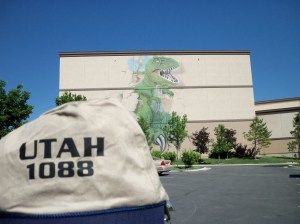
Museum of Ancient Life, Lehi UT, 2933 pts

The home stretch

Once I bagged the 2933-pt dinosaur, I didn’t have much left to do except ride and ride and ride back to the hotel. I didn’t dare stray from the Main Route because I needed miles and I didn’t want to get stuck on the SLC-to-Wendover Ride-Of-Shame. So I rode west on 73 through Lehi, trusted the RM when I found myself headed south, and then finally met up with USH-36 North to Tooele which I knew was well within reach of the hotel.

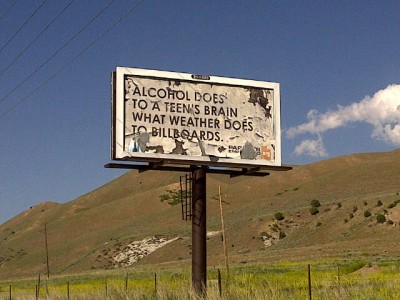
I found this billboard as I rode into Tooele, and decided it was worth a couple more illegal u-turns to capture for the Photo Blog.
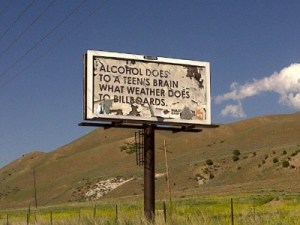
Best billboard I saw today. Had to go back and post it.

When I hit I-80 and headed east to the hotel, I knew I had to check my GPS mileage at the off-ramp. I was emotionally prepared to do another 20-mile round trip west to Saltair if needed, but as it turned out, I had more than enough miles and I was about 40 minutes early. Just to be sure, I did a few low-risk laps of Amelia Earhart Rd between 5600W and Wright Bros Drive (sort of a mini Ride-of-Shame) before I pulled into the hotel parking lot at 6:31pm.

Post-Rally Housekeeping

Scoring was very efficient. The rally staff recorded my finish time and mileage and certified that my driver’s license was still snugly sealed in the envelope (5000 points). I was directed inside where I had plenty of time to review my bonus answers, confirm they were legible, turn in my paperwork, and have my SD card scanned to verify I had taken the required photos.

With that, there was nothing left to do but unpack the bike, check Rich’s progress on his SPOT, and enjoy a casual dinner with a few of my friends on the rally staff. I had good reason to relax and celebrate – I had met both of my goals AND I had fun. And as it turned out, four of the seven riders entered in the 12-hour event had come in just a few minutes over time, thereby earning DNFs. Even though I was tired, I could do that math and so I knew before I went to bed that I had achieved a podium finish. I set my alarm for 5am so that I could watch the return of the real rallyists – the ones who rode the 24-hour and 3-day versions – including Rich.

Below is the Spotwalla map showing my actual route – click on the map for an interactive version to see things like my zig-zagging north of Dugway looking for the monument and my final back-and-forths before the finish line.

SPOT statellite tracker record of my ride

Next up: 2011 Utah 1088, Part III: Results and Review


2011 Utah 1088, Part I: Final Preparations

September 7, 2011

After months of preparing my bike (Farkles for the Ninjette), my gear (Body Farkles: Damn, 12 Hours is a Long Time), and my body (Shakedown Rides: Training for a 12 Hour Rally), I finally arrived in Salt Lake City on Thursday June 23. I’m entered in the 20th Anniversary of the MERA Utah 1088 endurance rally, 12-hour version, which starts on Saturday morning at 7am. Time to get serious.

Key Rally Concepts – a Primer

Rally Master (RM): The Rally Master designs the rally, and in many cases, plans and promotes the entire event. The MERA Utah 1088 is Steve Chalmers’ baby and has been since its inception in 1992. He does it all: offers up a wide variety of interesting Bonus opportunities and routing options, organizes the post-rally awards banquet and bar-fest, and laser-etches all of the awards. He is known for his clear instructions (no gimmicks), fair scoring, and devious and sometimes twisted sense of humor about bonus selection. For the latter, he has been affectionately dubbed the “Rally-Bastard”.

All The Gear, All The Time (ATGATT): This is the slogan of all the serious motorcyclists I know – own the right gear and wear it whenever you’re on the bike. In other words, there is never a good reason or excuse for riding in tank tops, shorts, sandals, or <shudder> without a helmet. On this rally, failure to wear helmet, boots and gloves at any time during the rally results in Disqualification. Most riders also wear full riding suits with armor/padding.

Did Not Finish (DNF): The basic goal of all rallyists is to Finish. Finishing criteria varies from rally to rally, but nobody wants a DNF next to their name.

Checkpoint (CP): In this rally, there was a single checkpoint with a narrow window of time. Missing it results in a DNF. The only exemption was for riders who opted for the Alternate Route (described later).

Bonus opportunities (“Boni”): Finishing position is determined by total points, which are accumulated by collecting Boni – sort of a two-wheeled scavenger hunt. Descriptions and requirements for these bonus opportunities are scattered amongst the Main Route instructions. Bonus opportunities fall into two basic categories:

  1. Those available along the route. Some are right on the Main Route and easily obtainable; others require some extra effort or miles. Point values for each roughly correspond to the degree of difficulty. Often the highest point bonuses are red herrings, doable perhaps, but more likely to result in a DNF for greedy rallyists. In this rally, the bonus values along the Main Route route ranged from 865 to 3625 with additional options up to 4697 points.
  2. Those available regardless of the route. The points for these are tied to the importance to the Rally Master. There were two on this rally:
  • 5000 points were awarded for avoiding an encounter with law enforcement (and 7500 deducted if you did not) – this incentive helps maintain the reputation of the rally. The concept is simple: our driver’s licenses are sealed in an envelope before the rally. Return with the envelope intact = earn 5000 points; return with a torn envelope = deduct 7500 points. This rally has been running in Utah for so long that veteran troopers have been known to pull a rider over, ask for the envelope, tear off the corner, and send the rider on his/her way without a ticket – knowing that they had already inflicted enough pain. There are lots of stories of creative avoidance tactics to avoid the dreaded “envelope tear” – begging, lying, whatever, some successful, some not – in my book, this is legit. Some experienced rallyists carry duplicate licenses – that just feels like cheating to me. My plan, if faced with the problem, was to point out that a 250cc “not much more than a scooter” motorcycle couldn’t POSSIBLY have been going that fast.
  • 7500 points were awarded for carrying a SPOT satellite tracker – this gives the Rally Master peace of mind because he can keep track of his “ducklings” while they are out. We were informed prior to the rally that use of the SPOT was “strongly suggested” and that we would be highly rewarded with points for compliance. No brainer there, Rich and I embraced the SPOT years ago and had already acquired a second one for my solo travels with the RV and the dogs.

The Plan

Going into this rally, I had two simple goals: (1) stay upright and healthy, and (2) finish. Most rallyists list “have fun” at the top of their goals, but I figured the other two were more important and having fun would be the natural result of accomplishing my goals. I did not want to be listed in the results as a DNF. The requirements for finishing are deceptively simple:

  1. Leave the hotel no earlier than 7:00am
  2. Make the mandatory Checkpoint within the prescribed time window
  3. Ride at least 544 miles
  4. Return to the hotel by 7:00pm (there is NO slack – 7:01pm is a DNF)

My shakedown rides had taught me that maintaining the 45.33 mph average to meet these criteria was not an easy task. That average has to account for all downtime, including fuel and potty stops, checkpoint and bonus administration, sustenance and hydration, clothing changes and gear adjustment, etc. And it also has to be sustained in the face of unanticipated delays like construction, traffic and weather.

Since maintaining that average was key to my goal, I showed up at the rally with the following fundamentals firmly embedded in my brain:

  1. Minimize non-riding time while ON the clock. The adage amongst experienced and successful rallyists is that every minute off the bike is a mile lost on the road.
  2. Maximize the use of time while OFF the clock. Arriving at the checkpoint before it opens gives you “free” time to take care of all that business that otherwise detracts from #1.
  3. Minimize high-risk routing and bonus choices. Examples:
  • Bonuses that require extra miles may seem doable on paper if all goes well, but also have high potential to result in a DNF due to unforeseen factors like construction and local traffic.
  • You don’t have to follow the route instructions exactly, and in fact, except for making the CP, you don’t have to follow the route instructions at all. Alternate roads may get you to the same place with less time and less work, thereby less risk.
  1. Organize my gear to optimize access to the things that impact downtime. This may be the most important thing and the most often overlooked by rookies. The common theme here is “attached to (or easily-accessible in) the tank bag”.
  • Paperwork (e.g. route instructions) – 3-hole sheet protectors attached to tank bag with mini-carabiners.
  • Pens – mini-sharpies with built-in key rings attached with carabiners to tank bag
  • Camera and hat – hat attached to camera strap attached to tank bag with carabiner
  • Hydration – my tank bag has a pocket for a bladder and a hole for the hose. But thanks to a tip from a fellow competitor, I made a key last-minute modification – a $1 “badge reel”. When properly affixed to the bite valve tubing and the tank bag, the reel caused the tube to retract to a reliably-accessible position for on-the-road hydration.
  • Sustenance – simple, effective, efficient. In other words, Gatorade, Boost and beef jerky in the tank bag.
  • Personal care – sunscreen and chapstick, easily accessible in the tank bag.

Odometer Check

The first official event of the rally is the odometer check. We were sent on a ~20-mile ride with very strict directions, including which driveways to exit and enter the parking lot. The purpose of this is to determine a correction factor for each participant’s mileage readings. For example, if the “official” distance of the odometer check was 20.0 miles, but my odometer showed 21.0, I would have to adjust my total mileage reading for the rally by a factor of 1.05. That is critical information because to meet the 544 mile finishing requirement, my odometer would actually have to read 571.2 (in this example). In my experience with Rich, most bikes are about 10% optimistic. I was prepared for this and had designed an hourly mileage landmark cheat sheet if necessary. As it turned out, my odometer was spot on – whew, one less thing to worry about.

Pre-Rally Routing

In all of the pre-rally announcements, the RM had stated that we would be receiving our route instructions just 15 minutes before the start. That’s not much time to come up with a plan and I was more than a little concerned. I had already decided that I would use that 15 minutes to find a way to get to the Checkpoint at least 30 minutes before it opened, with or without bonus points, and use that off-the-clock 30 minutes to route the remainder of the ride. To my enormous relief, he distributed the instructions on Friday night immediately following the rider’s meeting.

I went upstairs, fired up the laptop, and began the routing process. Our instructions were actually quite simple, and in a nutshell, my process went something like this:

  1. Highlight the Main Route on the map. The Main Route is clearly defined in the instructions by a series of simple commands like “80 West to 196; 196 South to 199; etc.” This gave me a baseline on where the RM wanted us to go. I knew from previous exposure that the route instructions are a suggestion, not a requirement.
  2. Enter and evaluate the Bonus List in Excel. This went quickly because there were only 16 offered and of those, only 13 were discretionary. The others were either gimme’s (enable SPOT tracking) or not relevant to routing (is my driver’s license envelope intact). I entered the basics – number, brief description, requirement (photo, receipt, answer question) and points. Then I sorted by point value, divided the list into thirds to determine cut-off points, and used Conditional Formatting to assign a color to each of the groups based on value (red=high, yellow=medium, green=low).
  3. Eliminate the Boni that didn’t fit my criteria. Referring back to my pre-rally planning, I was avoiding Boni that (a) took me off the bike, (b) went the wrong way, (c) added unnecessary mileage, or (d) added variables beyond my control. Staying true to this plan, I eliminated the following:

#1, the “alternate route”. Ride to St. George and get a receipt. Seriously? That’s a 600-mile round trip. This one provided an exemption for the CP requirement, but still, I’m stressed about getting 544 miles, let alone 600.
#2, which involved going east into SLC (the wrong direction) to get a signed business card from a bike shop (off the bike).
#5, the ever-popular shooting bonus, which involves going south of town (the wrong direction) and standing in line to shoot a gun (off the bike and variables beyond my control).
#12, the red-herring. Ride to Little America WY and get a gas receipt, with no exemption for the CP requirement. I didn’t enter this rally to spend my whole day on the Interstates (I-15 and I-80).

  1. Plot the remaining Boni on the computer and download routes to the GPS. There are as many opinions about the best way to do this as there are software options. I use Microsoft Streets & Trips because it’s fairly intuitive and pretty good at finding landmarks. Then I export the data to a format that Garmin’s Mapsource can use to download the data to my GPS (a trusty Garmin StreetPilot 2610 dubbed “Carmen”). I entered the 9 Boni that remained after the two previous elimination steps and found myself with a route that seemed to meet the time/mileage requirements. I further broke this down into two separate routes (“Start to CP” and “CP to Finish”) so I could accurately track my progress to the Checkpoint and ensure an early enough arrival to do my required maintenance off the clock (hydration, sustenance, fuel, sunscreen, potty, faceshield clean, etc.). I was prepared to blow off early Boni if necessary to do that.
  2. Prepare my working documents. This is the paperwork I would actually use on the road and involved three separate steps:
  • Update the map. I had already highlighted the Main Route, so I added labeled dots that corresponded to the bonus locations and color-coded values from the spreadsheet.

    Planned Route with Boni and CP marked

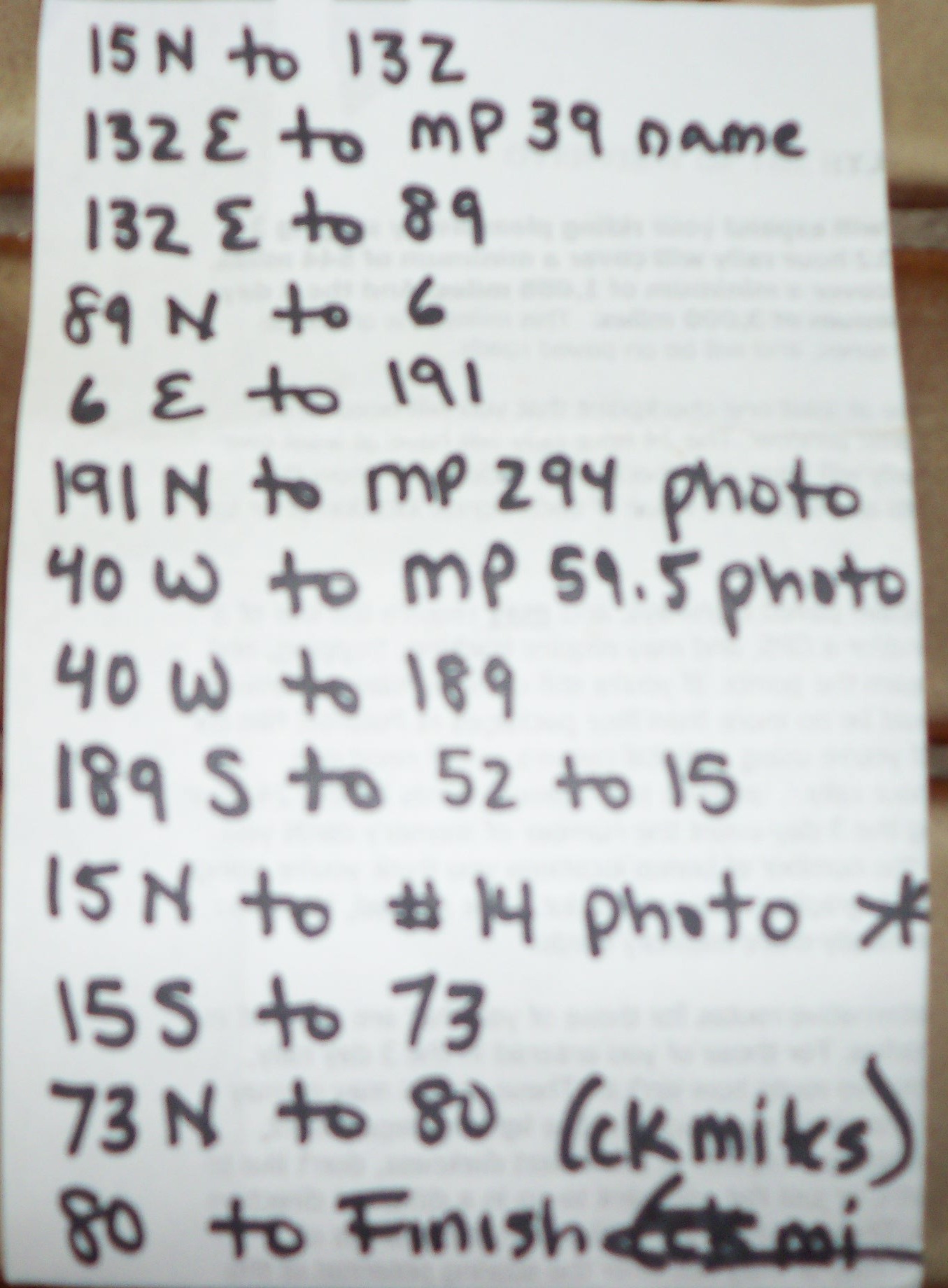
  • Create the cheat-sheets. Two simple lists of instructions to myself (Start-CP and CP-Finish), written with a Sharpie in large enough print to read on the fly as I was moving. Here is the 2nd list (CP-Finish).

    Cheat Sheet, CP to Finish

  • Protect and ‘bind’ the route instructions. The route instructions might as well be made of gold. They have blanks that need to be filled in for each bonus and checkpoint, and if you show up at the finish line without them, you’re toast. To avoid the risk of water damage or wind abduction, and also to simplify the process of recording the required information, I inserted each page in a plastic sheet protector, bound the pages together with tiny carabiners, and attached the bound set to my tank bag under the map flap. All I had to do to record my progress was open the Sharpie (which was also lashed to the tank bag), lift the map flap, and write the info on the sheet protector. I had already verified with the RM that I could record my information on the outside of the sheet protectors and turn them in that way.

Even with a few last-minute tweaks, I was done with all of the preparation by 11:00pm so I turned on the TV to check the weather, set both my alarm and wake-up call to 5:45am, checked Rich’s SPOT to be sure he was still moving (did I mention that he was half-way into his 3-day rally at this point?) and hit the sack.

Next up: 2011 Utah 1088, Part II: Rally Day!


Shakedown Rides: Training for a 12 Hour Rally

September 7, 2011

If you have read my earlier posts, you know that I bought a 250 Ninja that I love (Finally, a motorcycle just for me) and made some significant changes to make it more rideable (Farkles for the Ninjette). In addition, I made a crazy decision to enter a 12-hour rally, which resulted in some needed gear modifications (Body Farkles: Damn, 12 Hours is a Long Time).

For someone who rides as infrequently as I, the thought of riding for 12-hours straight is more than a little daunting. Fortunately, I had the sense to train by doing a series of shakedown rides. These were actually mini-rallies that very closely simulated the requirements I would be faced with on the actual rally. For each ride, Rich developed a list of bonus opportunities and gave me a time-frame. I went through the full exercise of reviewing the bonus list, weeding out the red herrings, routing a doable ride, and executing the plan.

I ended up doing three of these shakedown rides in the two months leading up to the event.

#1: Can I Even Do This?

Rich and I both used this ride to test our computer routing skills. We had the same bonus list and independently plotted our own routes. We would leave our home in Petaluma at the same time and meet for dinner at the Pacifico Restaurant in Calistoga 5 hours later. My route resulted in a beautiful tour of the Sonoma County coastal hills through Sebastopol and Graton, then up to the Alexander and Knights Valley wine regions, then over two sets of mountains into Lake County, and back to Calistoga. I have no idea what Rich did, but I’m pretty sure he got lost because he had been at the restaurant for over an hour by the time I got there.

Important take-aways from Shakedown Ride #1:

  • My new helmet needed some more break-in time. I developed an unpleasant jaw pain on the left side of my face. It finally subsided, but I was concerned.
  • My StreetPilot needed a sun visor (a common issue)
  • I definitely need a throttle lock
  • The changes we had made to my seat and riding position were perfect

#2: Riding in the Rain

I deliberately picked a very rainy day for the second ride. Rain is always a possibility in Utah and I needed to boost my riding confidence and test my gear. For this 3-hour ride, I went directly out to the coast (Tomales), headed south on Hwy 1 to Marin County, then came home on the freeway. I still had my bonus list to deal with, which meant managing cameras, Sharpies and paperwork in the rain.

Important take-aways from Shakedown Ride #2:

  • I needed a better plan for managing my paperwork than stuffing it into the chest pocket of my jacket. By the time I got to the first bonus question, it was a soggy unusable mess.
  • The time to put your over-gloves on is at the first hint of rain, not after your regular gloves are already soaked through.
  • My jacket and pants needed to be doused with Scotch-Guard
  • Hwy 1 sucks in the rain, not because of the wetness, but because of the mud, gravel, and eucalyptus droppings.
  • Riding in the rain isn’t as scary as it seems, as long as you stay away from the paint on the pavement (crosswalks, arrows, letters)

#3: Getting Serious About Distance

Rich had entered the Cal 24 Rally, which ended with a banquet at a hotel in San Jose. We thought it would be fun to have my final shakedown ride end there so I could join the participants for dinner. This was an 8-hour plan – first to San Francisco, then down the coast all the way to Castroville, over to 101, up 580 to Pleasanton, then back to the hotel in San Jose. This was the first ride that would require me to refuel (both the bike and my body), which adds the elements of fuel planning and time management. It was also going to entail a greater temperature variation than I had encountered before, which was going to put my riding gear to the test. It was chilly at 6am when I left home, but rose to the 80s mid-day in the valley.

Important take-aways from Shakedown Ride #3:

  • It isn’t as easy to average 45 mph when you have to stop for necessities in addition to bonus questions
  • The helmet problem identified on Ride #1 had disappeared – break-in was complete
  • The LDComfort top and tights worked as advertised – I never felt the need to add or shed any clothing
  • I survived 8 hours with a reasonable average speed, which made me pretty confident I could do 12.
  • That evening, I learned to manage the wind, as I found myself in an evil gusty cross-wind for most of the ride home.

With those three rides under my belt, my training was complete. All that was left to do was get to Utah and run the rally.

Next up: 2011 Utah 1088, Part I: Final Preparations


Body Farkles: Damn, 12 Hours is a Long Time

September 7, 2011

I love my new Ninjette, and after I bought it, I wasted no time doing some significant modifications. Most were needed to make the bike more rideable and a few were added on after I decided to enter a 12-hour rally. All are documented in a previous post, Farkles for the Ninjette.

While I was customizing the bike, I found myself having to reconsider my gear in parallel. You see, I managed to sign up for something completely crazy. My husband, Rich, is a dedicated endurance rallyist – which basically means averaging 1000 miles/day for however long the rally is. He has ridden dozens of 24-hour rallies over the past two decades, and in September 2010, he finished his first 10-day rally, the inaugural MERA 10-in-10. One of his favorites is the MERA Utah 1088, which celebrate its 20th anniversary in 2011. The Rally Master, a good friend of ours, decided to overlay a 3-day rally on top of the traditional 24-hour format. In a moment of delirium, I suggested that he consider embedding a shorter rally as well for people like me who just wanted to dip their toes in the water. I had in a mind a nice 4 to 6 hour ride, but the result was a 12-hour challenge. Are you kidding me? But since it was my idea, I was sort of stuck at least giving it a try. Yep, this dilettante is going on a very long ride on a very small bike.

Seriously, 12 hours on a Ninjette? As it turned out, very few of the farkles I ended up adding to the bike were solely motivated by this event – most notably the GPS shelf, sheepskin seat pad, and full set of luggage. The other items would have probably ended up on there eventually anyway.

But the decision to enter the rally did expose some deficiencies in my riding gear. Or as my friend Maura Gatensby so eloquently put it, “No such thing as bad weather, only bad clothes.” Here is what I’ve done to address that concept.

Under Gear

Problem: According to my more knowledgeable sources, after a few hours in the saddle, riders develop a condition commonly known as “monkey butt”.

Solution: The undisputed leader in monkey butt prevention is Mario Winkelman’s underwear, aka LD Comfort. The stuff isn’t cheap but it’s worth it. I wasn’t ready to spring for a full assortment, so on advice of trusted friends, I opted for a long-sleeve top and full-length tights. The assumption was that it’s better to be protected if it’s cold and let the wicking fabric do its job if it’s warm.

Ventilation / Face Access

Problem: My bop-around-town full-faced HJC helmet does not have the ventilation required for desert riding in Utah nor the flexibility required for stopping to take photos / write notes / get gas / drink water without removing said helmet.

Solution: I decided to get a flip-up helmet. Again, I wasn’t ready to fork out $500-600 for the market leader (Shoei), but I found that HJC made a perfectly adequate version in my price range. And since my everyday helmet was also an HJC, I didn’t have to worry about sizing or fit.

Hydration

Problem: Hours of riding in the Utah desert, no time to stop and drink.

Solution: One of the things I loved about the Dowco Tank Bag is that it is designed with a built-in pocket for a hydration bladder and a slot for the tube. Quick trip to REI to buy a bladder.

Ear Protection

Problem: The Ninjette cruises at 7000-8000 RPM. That’ll drive anybody crazy after a few hours.

Solution: I bought a set of custom-molded ear plugs from a Plug-Up at the San Mateo bike show, complete with a tether so I wouldn’t lose them and a cute little case to protect them. I added a small cord lock that turns the tether into a sort of a bolo tie so they don’t fall off when I take them out.

Body Armor

Problem: I love my Joe Rocket Ballistic jacket and pants, but the hard plastic body armor is miserable. I feel like a transformer robot in the jacket and the knee pads dig in to my legs most uncomfortably.

Solution: Rich had already discovered T-Pro soft armor from Forcefield. They’re made of some sort of space-age foam that is supposed to provide the nearly the same protection as the hard armor. I replaced the knee pads in my pants, but left the hard hip pads in place because they weren’t bugging me. And I replaced the elbow and shoulder pads to soften up the jacket but left the hard back protector in. The bad news is that we can’t find a source in the U.S. anymore.

Warmth and Dryness

Problem: In contrast to the big touring bikes, I don’t have a lot of protection from the elements. Staying warm and staying dry will be challenging.

Solution #1: I already mentioned that Rich dug up a Widder electric vest and wired a plug into a side panel on the bike.

Solution #2: I have some decent insulated snowmobile gloves and didn’t see any reason to buy fancy new expensive ones for the unlikely event of rain. Instead, I bought a pair of Aerostich Triple-Digit Rain Covers. Half glove, half mitten – they are waterproof and fit over my warm gloves. Problem solved.

So now my bike is ready, my gear is ready, I just need to get myself ready. Time for some Shakedown Rides.


Farkles for the Ninjette

May 30, 2011

Farkle: Accessory. The word is generally accepted to mean a combination of “function” and “sparkle”, hence, farkle. Motorcycle enthusiasts may install accessories, called farkles to customize their machine.

Ninjette: Nickname for the Kawasaki Ninja 250R motorcycle. The 250R is the smallest “Ninja” motorcycle that Kawasaki manufactures.

(Source: urbandictionary.com)

If you read my previous posts (Finally, a Motorcycle Just for Me), you already know how I ended up with a 2010 Kawasaki Ninja 250R Special Edition. Most bikes that arrive in our garage, even brand new ones, start life by being taken apart and rebuilt several times before they are “ready”. But this bike is so nearly perfect out of the box (and Rich won’t ride it, which helps), that I was hoping this extra step would not be required.

It only took one 100-mile ride to remind me that no bike is perfect. I quickly identified areas that needed attention to make it safer, more rideable, and even more attractive. Then, against my better judgment, I decided to enter a 12-hour endurance rally in June. That decision exposed a whole new level of farkling necessities. The resulting laundry list turned into a joint project over the winter and a long list of modifications which I have documented in this article. I’m not including a cost tally because I choose to remain in denial.

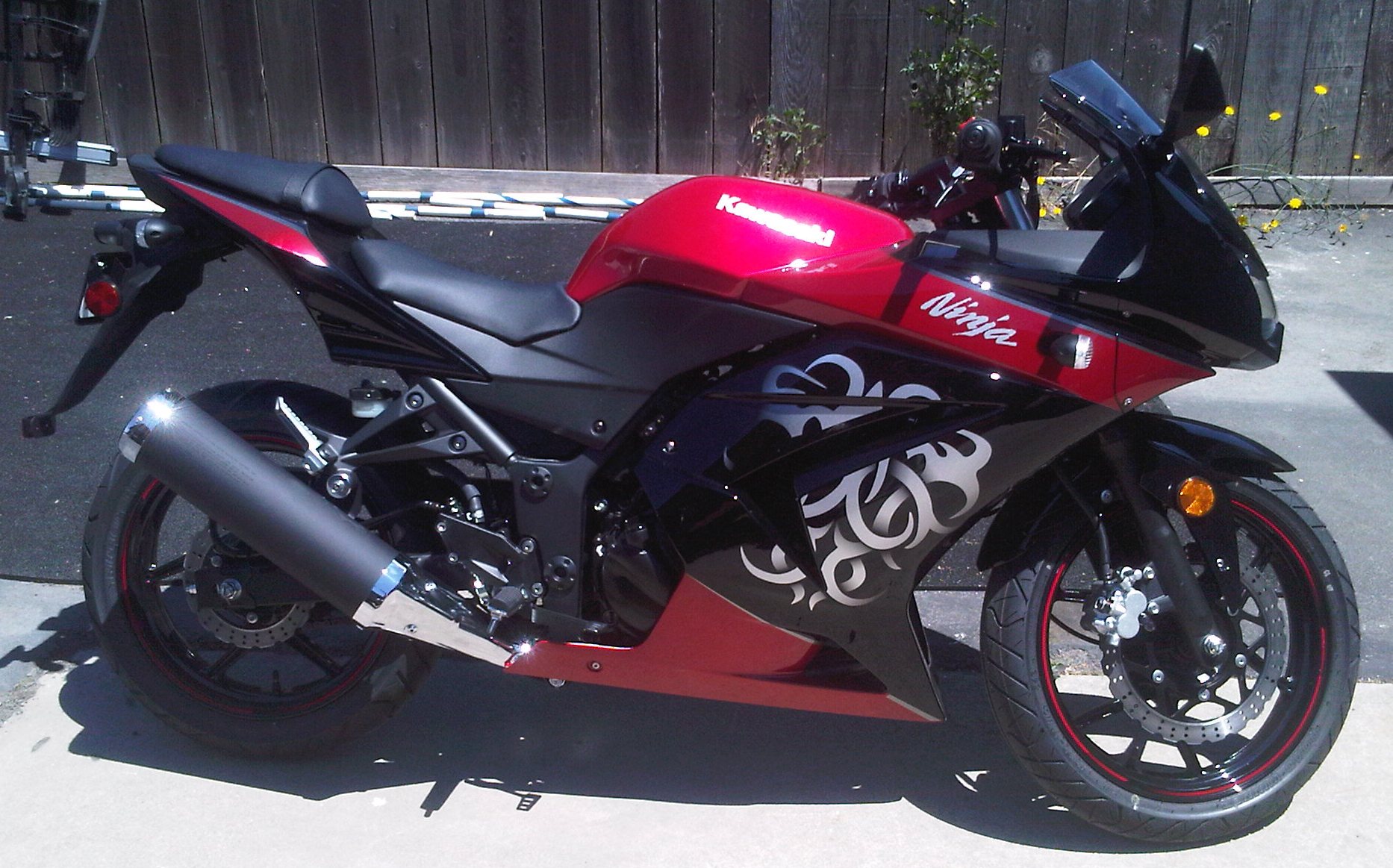
Here is a photo I took last July, right after I bought it and before my first ride (other than getting it home). No modifications had yet been made when this photo was taken.

As delivered, right after I bought it - the "BEFORE" photo

Riding Comfort

Riding position

Problem: The sporty riding position on the Ninjette is designed for 18-year-old kids with bodies that bend like Gumby – extreme angle on the knees and hips and a lot of weight on the wrists. It’s an inherently tiring position, but the target audience isn’t likely to ride for more than about 50 miles at a time. I needed to do some work to make it more suitable for an old lady like me.

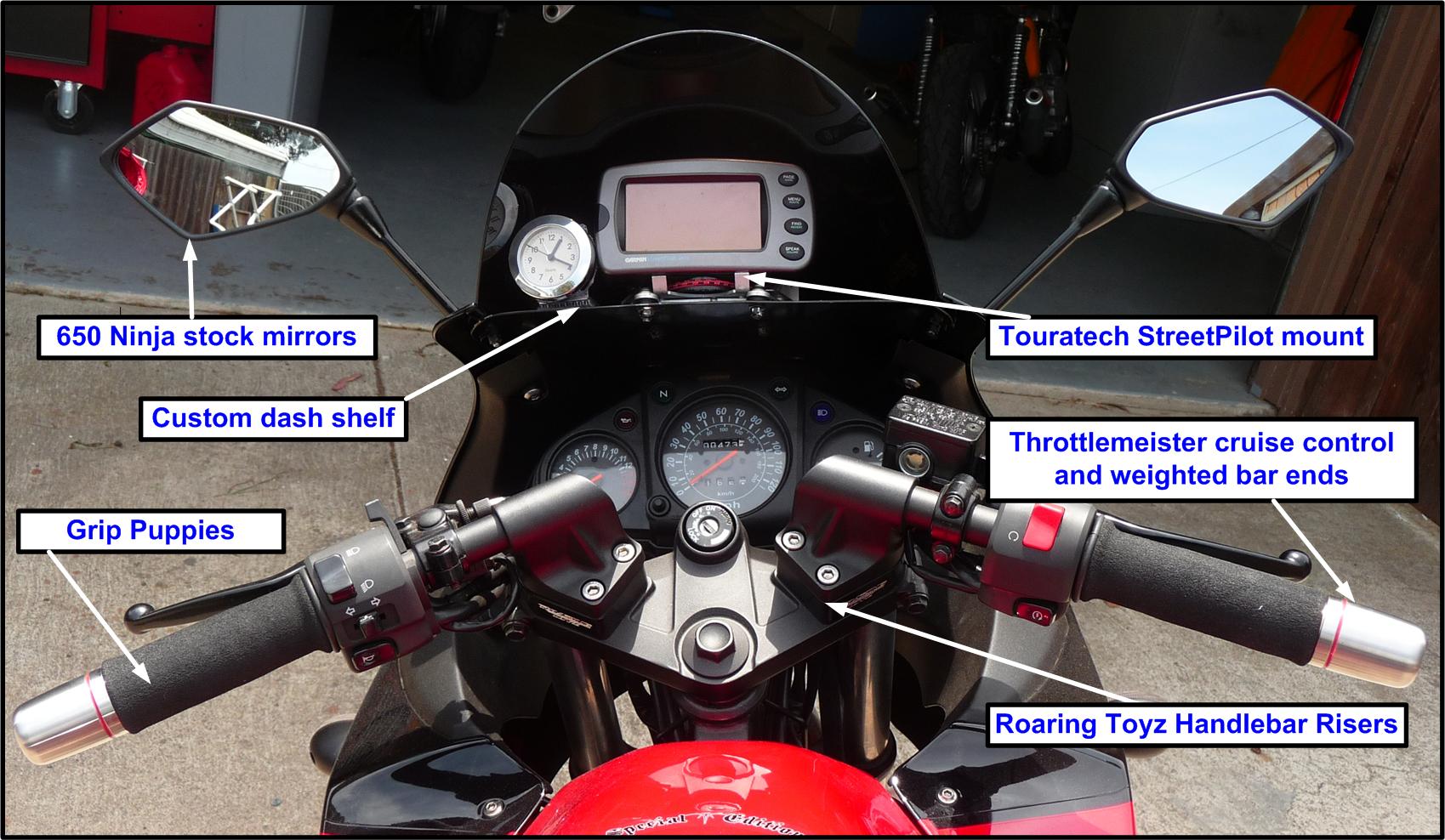
Solution 1: We addressed the wrist problem by adding Roaring Toyz Handlebar Risers. These are designed to kick up the bar height by 1-1/2″ without sacrificing the wrist angle.

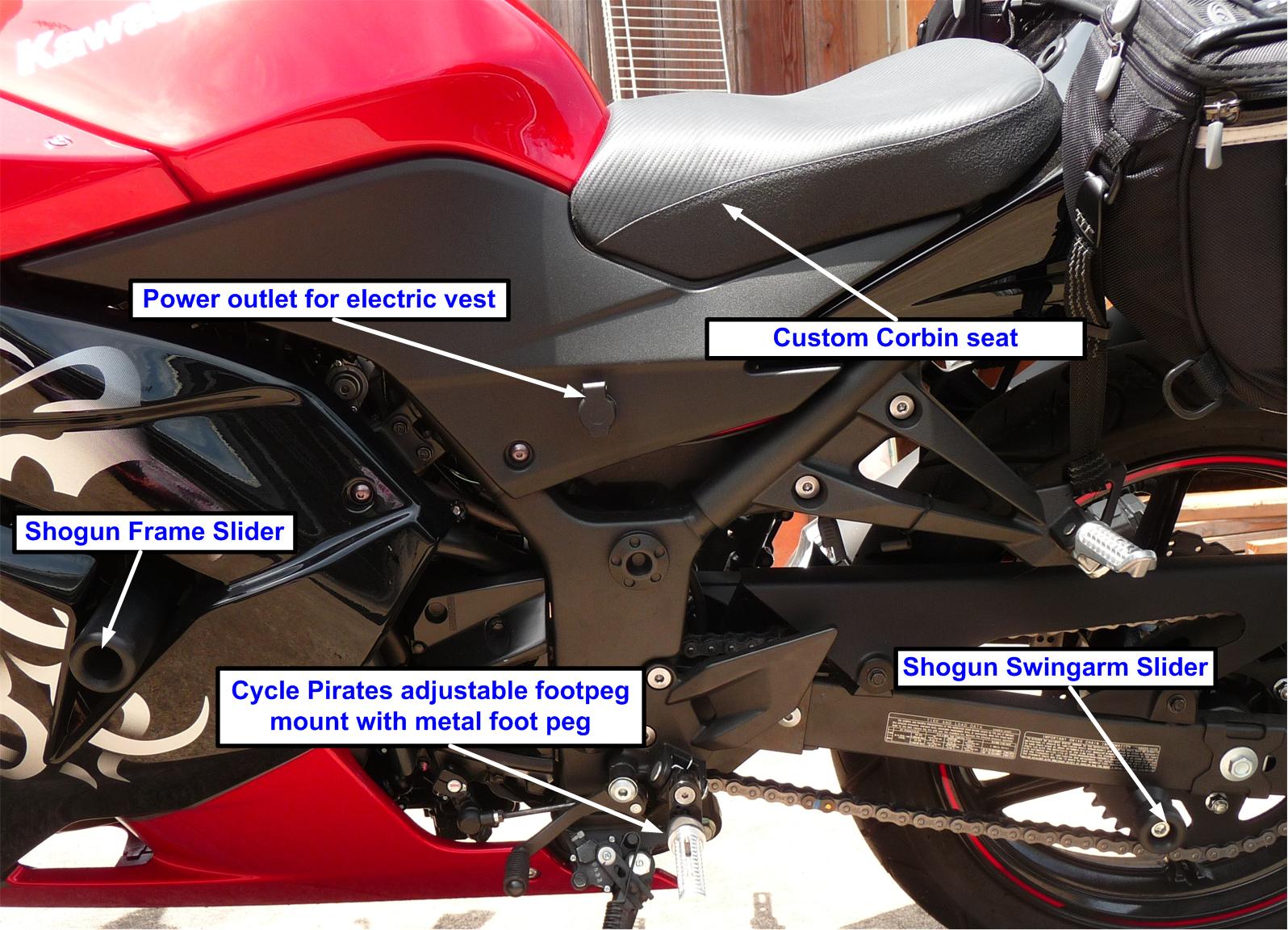
Solution 2: We dealt with the knees and hips by dropping the foot pegs an inch with the Cycle Pirates Adjustable Footpeg Mounting Kit. This mod required a significant amount of work and is not for the faint-of-heart. Though the brackets themselves bolted on, (a) they don’t use the stock footpegs and (b) the brake and shift levers had to be adjusted to match the new position. Rich took the opportunity to replace the rubber-clad footpegs with some metal ones, which gained me an extra 1/4″. I always wear boots so I didn’t even notice the slight increase in vibration.

Seat Enhancement

Problem: As with most bikes, the stock seat leaves much to be desired. When I test-rode it at the dealership I thought I might get away with it. My first shakedown ride convinced me otherwise.

Solution 1: We have always had good luck with custom seats from Corbin – we have put them on at least 10 bikes in the past two decades. They are not the elite seat-makers for long-distance riding, but I didn’t want or need a $1000+ custom seat. Corbin had a front seat replacement in their catalog that didn’t require me to send in my stock seat. As it turned out, the off-the-rack Corbin seat didn’t work for me either – it was canted forward in a way that shoved me into the tank, exacerbating the riding position problem. When I contacted Corbin for advice (intending to return it) they offered to adjust it. We took the bike down to get it “modified” – instead I ended up with a brand-new fully-customized seat at no additional charge. Kudos!

Solution 2: I decided I would probably want a little more comfort for the 12-hour ride so I added an Alaska Sheepskin Buttpad. The Pillion I fits the rider’s seat on the Ninja perfectly.

Bonus: The customization on the seat added another inch or so between my hips and the footpegs, thus reducing the stress on my hips and knees even more. The Ninjette has a very low seat height out of the box (one of the reasons I love it) and I’m tall enough that I still have plenty of room to spare even with the increased height of the seat. I haven’t tested the sheepskin yet, but it’s so thick that I’m guessing I’ll get another 1/2″ out of it. Every fraction matters!

Supplemental Warmth

Problem: The rally is in Utah in June. It is just as likely to be 40 degrees in the mountains as it is to be 100 degrees in the valley. With very little protection from the fairing, I needed a way to keep warm.

Solution: Rich found a Widder electric vest in the garage that doesn’t fit him anymore. He installed a Powerlet plug on the side of the bike right below the seat.

Replacement windscreen

Problem: Though the stock fairing and windshield are surprisingly effective on the freeway (compared to the unfaired ER-6N), I did feel like I would want a little more coverage for longer rides. This became even more apparent after I modified the riding position.

Solution: Zero Gravity offers 3 different replacement shields for the Ninjette. I opted for the Sport-Touring model, which is the tallest option. I chose Dark Smoke because it looks so much better on the bike and the screen is still low enough that I rarely look through it anyway.

Handlebar Vibration and Throttle Control

Problem: The hard-rubber handlebar grips transmit quite a bit of vibration. This problem isn’t specific to the Ninjette, but because it cruises at 7000-8000 rpm it is more noticeable than most, especially on longer rides.

Solution: Grip Puppies are simple covers made of dense foam. In addition to reducing vibration, they also relax the hand by adding diameter. They don’t last forever but they don’t cost much either.

Problem: Nobody can hold a twist throttle on for 12 hours. At least I can’t. Especially after sustaining permanent damage to my right ulnar nerve following an elbow fracture in 1982.

Solution: I solved two problems at once by adding ThrottleMeister cruise control and bar-end weights. The Grip Puppies weren’t quite enough to resolve the handlebar vibrations and bar-end weights were the next logical step. The ThrottleMeister isn’t the cheapest throttle lock available, but it is widely-accepted as the best and simplest to use. We special-ordered it from our local friends at CA Sport Touring.

Safety and Visibility

Rear-end Lighting

Problem: Most bad motorcycle accidents involving other vehicles are caused by (a) cars turning left in front of them or (b) being rear-ended. Visibility from the rear is key to mitigating (b) – the more light the better, especially under braking. Motorcycle tail lights and turn signals, with their small reflectors and old-school incandescent bulbs, are woefully inadequate. Fortunately, LED technology has opened up the world of lighting in low-voltage applications.

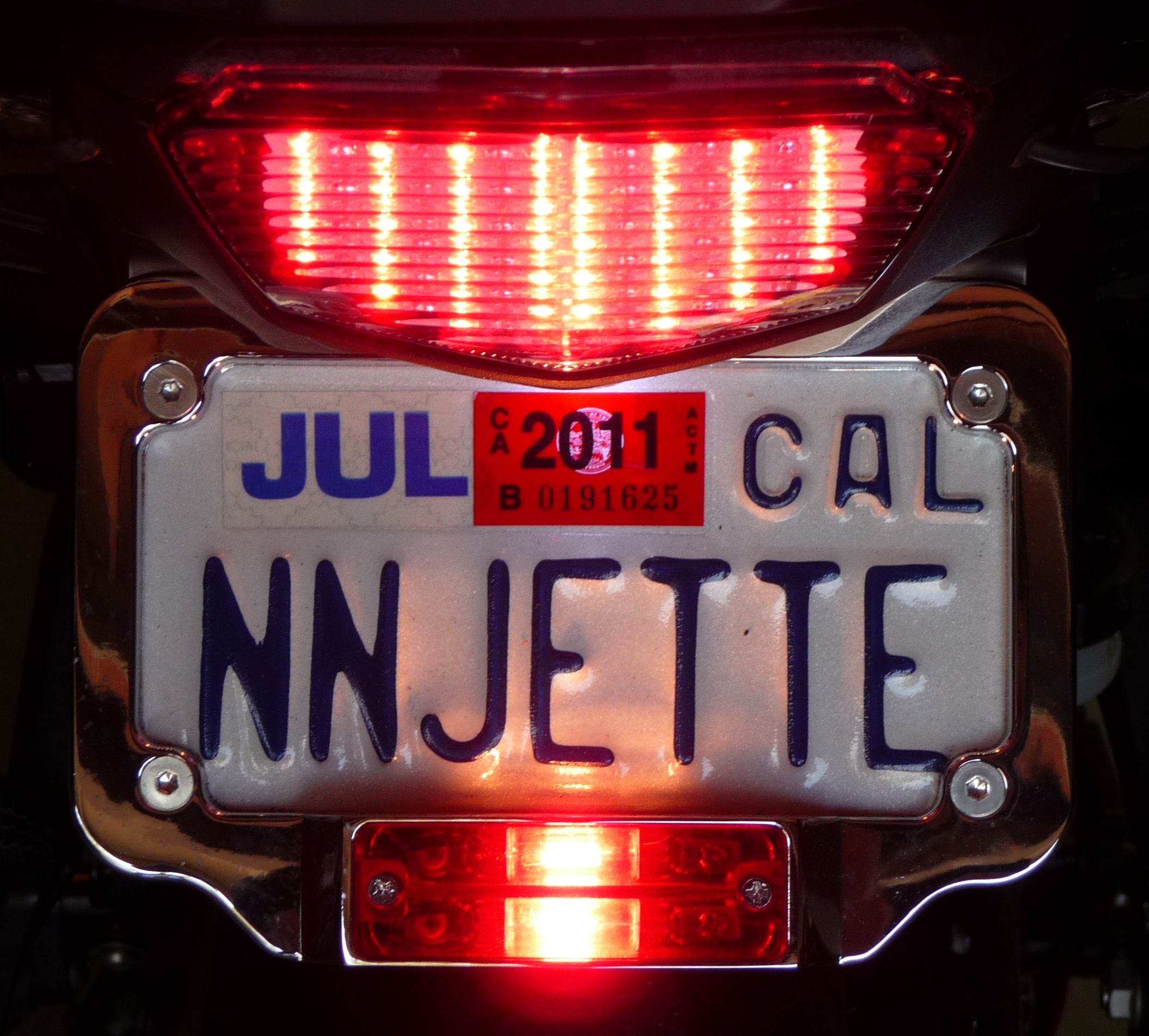
Solution 1: LED Integrated Tail Light With Turn Signals. This solution also addressed a problem that was both aesthetic and practical – the stock turn signals (on their mandated stalks) are not only ugly, but they are in the way of adding saddle bags.

Solution 2: To get even more light (and replace the ugly dealer license plate frame), we installed a chrome frame with an integrated brake light from Custom Dynamics.

Solution 3: Finally, we added amber LEDs from AdMore Lighting to the side body panels to enhance the visibility of the turn signals.

Audible Warning System

Problem: If the cars can’t (or won’t) see you, they need to be able to hear you. The stock horn is just pathetic.

Solution: Rich mounted a 139dB Stebel Nautilus Compact Motorcycle Air Horn in front of the forks under the fairing. He had to trim out some notches in the plastic but he finished it so nicely it looks like it came that way.

Seeing What’s Around Me

Problem: The stock mirrors are designed for looks, not function. Again, this “reflects” (ha-ha) the assumption that sport riders care more about what’s in front of them than what’s behind. Unfortunately, I DO like to know what’s back there (or next to me) and all I could see was my own arms and shoulders.

Solution: The factory Ninja 650R mirrors have longer stalks and bolt right on to the existing brackets (Ron Ayers Motorsports had the best price). The front of the bike looks a little gawkier now but it’s worth it – they completely opened up my view to the side and behind me.

Aesthetics and Functionality

Rear-end Aesthetics

Problem: The rear fender/license plate holder (as required by California law) is butt-ugly. It had to go – I’ll risk the fix-it ticket.

Solution: Installing the Competition Werkes Fender Eliminator kit was a relatively simple fix. It did require some trimming of the plastic mounting plate but it is well-illustrated in the instructions. The kit includes a replacement for the license plate mount and light.

Storage

Problem: There is no storage on this tiny little thing.

Solution 1: Cycle Guys FastPack Tail Bag and a cheap magnetic tank bag. I found the tank bag at the annual Cycle Gear yard sale in Benicia – if you haven’t been there, get on their mailing list for next year.

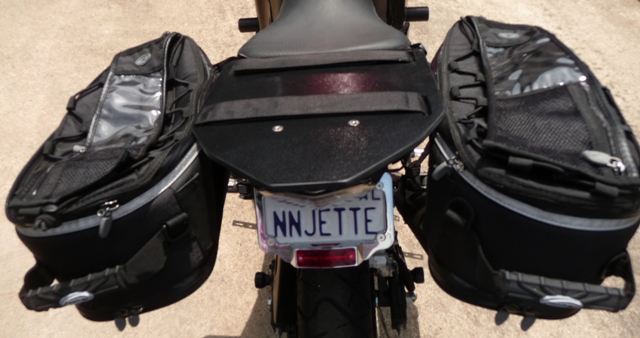
Solution 2: After I entered the rally, I realized that I would need to carry a lot more stuff than my little seat pack and tank bag can hold. I stumbled on the Dowco Fastrax Sport Elite Series at the San Mateo bike show last winter. I’ve looked at a lot of luggage over the decades and I liked everything about these bags. They are small (which means they don’t overwhelm the Ninjette) but extremely well thought out. I bought the tank bag and saddle bags on the spot and ordered the tail pack soon after. I will still use the small cheaper bags for bopping around town.

Solution 3: The shape of the rear bodywork is not really compatible with saddlebags – if I cinched them tight over the top they stuck out sideways, and if I loosened them up they drooped into the exhaust. Rich overcame the problem by building a custom nylon plate that bolts on in place of the rear seat and supports the saddlebags in a more natural position. It also supplies a firm level mount for the tail pack.

Navigation

Problem: I’ll need to use a GPS for the rally and there’s no place to put it (or connect it).

Solution: Rich custom built a dash shelf under the windscreen, modified and mounted a Touratech StreetPilot bracket that he found in the shop, and hard-wired the power cable. My friend upgraded to a Nuvi for her RV and generously gave me her old StreetPilot 2610 for my birthday.

Protecting the bodywork

Problem: This bike has more bodywork than any other I’ve had, which means a simple tip-over is likely to be really expensive.

Solution: Shogun Frame Sliders and Swing-arm Sliders. I did considerable research before deciding on the Shoguns. Most frame sliders attach only by the top engine bolt, which means they can actually cause MORE damage in a crash because they transmit all of the force to the engine head. The Shoguns attach to both the top and bottom engine bolts so that that the energy is distributed and less likely to cause damage.

Electricity

Problem: If you have been keeping track, you’ll note that we have added several electrical accessories – GPS, electric vest, horn. The electrical system on this (and most) bikes isn’t built to handle this.

Solution: Added a Fuzeblock under the seat. This provided all of the additional fusing capacity we needed to protect the bike from our electrical enhancements.

View of the dash, showing the shelf, mirrors and handlebar mods

Side view, showing the pegs, sliders, power plug, and seat

As you might imagine, there was a lot of Googling involved with researching and narrowing down some of these choices, especially the bolder ones like bolting on a pair of 650 mirrors to a 250. The resources that I found most useful were forum discussions on several sites:

  1. I got a tremendous amount of Ninjette-specific information from Ninjette.org, Ninja250forum.com, and 250ninja.org. All three are great for mining information using Google.
  2. Many of the generic items we added (horn, grips, dash shelf, etc) had already been installed on Rich’s ST1300 as he went through the process of prepping it for his serious rallies. The most valuable resource for that discovery and research was the ST1300 Owners Club forum.

This project was a joint effort, but I need to especially thank Rich for doing most (actually all) of the hard work. My part was easy – research, decide, buy, open the box like a kid at Christmas, and enjoy the result after it magically appeared on the bike. As you might imagine, there was a lot of hard work and shop time behind the curtain. But Rich loves pimping rides and takes the most pride when nobody notices that anything has changed. To quote his late great friend Paul Unmacht, everything he does looks “factwy”. The Ninjette is no exception.

Here is the “AFTER” photo with all of the modifications in place. Hopefully, if you hadn’t read this article, you might not have even realized that any changes had been made (not counting the luggage). Mission accomplished.

The "AFTER" photo - all modifications complete

P.S. I also developed an additional list of “body” farkles that are required to survive 12 hours in the saddle, but since they aren’t specific to the bike I’ve covered them separately in Body Farkles: Damn, 12 Hours is a Long Time.

P.P.S. You may have noticed the vanity plate in the photos of the back of the bike. I love my vanity plates and I’m not ashamed to admit it. But never in a million years did I expect to secure such a perfect plate for this bike. SCORE!!!


Is it an iPad? Maybe a Xoom? NO, it’s a ViewSonic GTablet!

April 10, 2011

Over the past year or so, I have had considerable pressure to enter the Tablet market. Some is peer-induced, which I covered in my first iPad post, and some is self-induced, borne of the realization that we need a backup eReader to supplement the Kindle.

As I review my original iPad post and the use cases I proposed, I have the following updates:

Media-rich newspapers: Nothing has changed here. I still don’t make time for a national newspaper, and as far as I know, the local rag (Press-Democrat) hasn’t adopted the format.

Media-rich magazines: As it turns out, at least one of the niche magazines that comes to our house, Clean Run, has made a significant effort to delve into the digital world. They now have a digital edition which is available through any web browser, and their digital publisher has already launched an iPad app (can an Android app be far behind?). Hmm, this is getting more interesting.

Watching videos. This is still my most compelling use case, even with the streaming constraints of the cellular networks and the input constraints of the iPad. I have already ripped my dog-training DVDs so I can watch them on my iPod Nano and Blackberry. It goes without saying that the tablets beat the handhelds in screen size, plus they bring a 10-hour battery life which is unapproachable in the laptop world. Now it’s starting to get really interesting.

Kindle backup. Yep, we need something. I concluded in my Kindle update that the Blackberry Kindle Reader is quite adequate in a pinch but not suited for long reading sessions. And I can’t quite justify a second Kindle when weighed against the added value and features of the tablets.

Fortunately, the tablet market has evolved along with my needs and the iPad is no longer the only option. Google’s Android operating system, which has been so successful in the smartphone market, has been extended to tablets and several manufacturers have already responded. And HP, which bought Palm and rebranded it as webOS, has also announced a new tablet offering (although it may be too little too late). This changes everything in terms of tablet decisions. In some ways it’s easier (I’m not forced to drink the Apple iBorg kool-aid), but the added options also add to the complexity of the decision (Android vs. HP WebOS, WiFi-only vs 3G/4G, AT&T/Verizon/Sprint).

Based on the growth of the Android app market and the openness of the operating system (in contrast to the iBorg), I had already concluded that Android would be my platform of choice. I was well on my way down the path of the Motorola Xoom when I encountered two significant stumbling blocks:

  1. The $800 3G version is only available on Verizon, and the only way to buy it at the discounted price of $600 is to commit to a 2-year plan at a minimum of $20/month. Total cost: $1,280 plus tax and accessories. HUH??? I don’t think so.
  2. The WiFi-only version hasn’t been released yet and is expected to be priced at $600, not exactly a dip-your-toes-into-the-tablet-world price.

During my struggle with all of this data, my good friend Jason just happened to notice the Woot of the day at woot.com, a ViewSonic GTablet (Android-based, wi-fi only) for $280. Those of you with Woot experience know that the good stuff sells out quickly. But it was enough money that I wasn’t ready to push the button without doing a little more research. During the course of the day I was able to determine the following key pieces of information about this particular device:

  1. It is listed on Amazon for about $340 so the Woot price was righteous. It is now available on other sites for $310, but still, $280 was a darned good price.
  2. The hardware specs kick some serious butt
  3. The user interface (UI) provided by ViewSonic sucks (it’s called Tap ‘n Tap – seriously?)
  4. Because of the aforementioned openness of the Android operating system, #3 was easily overcome (OK, you have to be a bit of a geek…)
  5. Everything required to deal with #4 is (a) free, (b) well-documented on youtube and various forums, and (c) well-understood by Jason (who has been hacking his Droid phone for months)

By the time I had concluded that this Woot deal was a financially feasible way for me to experiment with both a tablet and the Android OS, I was sure that the opportunity would have been lost. NOT SO! I clicked “I Want One” and here I am, the proud new owner of an Android Wi-Fi Tablet!

I have now rooted it and replaced the ROM. Or for those of you who don’t speak geek, I have taken over the hardware and replaced the stock Tap ‘n Tap interface and in doing so, effectively voided the warranty – a leap of faith not for the faint of heart. But the result is a kick-ass tablet that I’m thrilled to have in my arsenal.

My videos are awesome, the web browsing experience is fantastic, the Google app store is great and the Amazon app store is even better, and it is much better than my Blackberry for reading Kindle books. Even so, I will reiterate that the Kindle (with its eInk technology) will continue to thrive – LCDs (including this one) are terrible in natural light.

There is a dark side to my decision – this thing came with Angry Birds. I had been SO determined to ignore and avoid it, if only to justify my reverse iPhone snobbery. But there it was … I was only going to try it once …  really … CRAP!!!!!!

Hi, my name is Holly and I’m an Angry-Bird-aholic.


Kindle Update – one year later

March 23, 2011

When I bought my Kindle last January, I published my initial impressions in Kindling a New Reading Option. Now that I’ve had it for over a year, I thought I’d take a look back at how the Kindle has met (and in most cases, exceeded) our needs. Here is a review of my original goals:

  1. Did the Kindle handle my primary use case? Yes. My original motivation for buying it was to eliminate hauling a 30-lb box of books up to the cabin during my multi-week summer jaunts. The Kindle provided 10-oz alternative with a 2-week battery life. It also offered car-charging and free 3G downloads of new material when I headed down the mountain to do laundry at Tahoe. Two Thumbs Up.
  2. Can two people share one Kindle? Maybe not everybody, but we certainly can. And that is enhanced by the free Kindle apps that are available on other platforms. If the Kindle is not available for whatever reason (Rich has it, the battery’s dead, I don’t know where it is at the moment), the reading experience on my Blackberry Torch is quite adequate. And because of the Sync to Furthest Page feature, the transition from device to device is seamless. Love It.

But wait, there’s more. As I have embraced the Kindle and explored the Kindle world, I have uncovered some features and resources that are worth sharing.

Free Sample Chapters

Perhaps the most under-appreciated feature of the Kindle store is the Free Sample Chapter link, which is available with a single-click for most of the offerings in the store. What makes this feature so great?

  • If you have read several print books by a favorite author, you might not remember which ones by the Title alone. By reviewing a Sample Chapter, you can quickly recognize if you have already read the book before you make a costly mistake and buy it again.
  • If a friend has recommended a new book or author, or you happen upon something vaguely interesting in the Amazon Recommendations, you can test them out and make your own choice with no financial commitment.
  • If you are browsing the book store, you can use Sample Chapters as a Wish List / bookmark / reminder for future purchases.

Although the Sample Chapter is a great feature, it is not without flaws and does have some room for improvement:

  • If you are reading a Sample Chapter and decide to buy the book, there is no correlation between the two. In other words, it doesn’t keep track of how far I got and sync that up with the actual book when I buy it. It should.
  • The Buy Now option at the end of the Sample Chapter is instantaneous – it doesn’t show the price (which might be more than you wanted to pay) or provide for confirmation. There is a workaround however – use Go to Store instead of Buy Now.
  • If you buy the book, the Sample Chapter is left as a turd on the device. It should be smarter than that and delete the Sample when the book is purchased and downloaded.

Redefining Publishing

One of the most exciting things about the Kindle framework is that it gives new authors a way to get published and recognized. Traditional publishing is expensive and represents a significant investment for the publishing houses – they aren’t willing to take chances on unknown authors. Publishing on Kindle provides a free and very interesting alternative, with the following features for the consumers:

  • Many books under $2 (and even free)
  • Instant ratings and comments provide feedback so we can easily tell if they suck or not
  • Even established authors and publishing houses are offering free and cheap books to hook you (e.g. I got the first two Stieg Larsson books for $5 each, but I’ll probably pay full price for the third…)

Again, there is a downside – many books are being published without benefit of professional editing, which can have disastrous results. But that is why the ratings are so important.

So, how do you find out about these low-price offers? I subscribed to the iReader Review blog and over the course of the past few weeks, have filled my Kindle with free and cheap books. Not all of the emails are interesting, but it’s worth it to have someone else do the work of finding the deals.

What’s Next?

Since Rich and I have both embraced the Kindle, I was exploring the option of buying another eReader (the Kindle3 has some tempting new features). I quickly concluded that the better solution is to supplement it with some sort of Tablet. The Kindle is as close to perfect as an eReader can be, but that is really all it is. It doesn’t make sense to have two when a Tablet would more than suffice as a backup eReader and do so much more.

So, which Tablet to get? That will be the subject of my next entry….


Splenic Tumors in Dogs – a Lay Person’s View

February 24, 2011

Bad things happen in the spleens of dogs. I don’t know why, I just know they do.

Medically speaking, canine splenic masses typically start as unremarkable “nodules”. From there, they often transform into one of two types of masses: hemangioma (a benign tumor) and hemangiosarcoma (a malignant cancer). Other types of masses also occur but these two are the most common. Unfortunately, because the spleen is a vascular organ, even the benign ones often have tragic results.

In my experience (and that of many dear friends), splenic masses result in one of the following three outcomes, often without diagnosis or warning:

  1. They rupture and the dogs bleed to death
  2. They metastasize and the dogs die of cancer in other organs (lungs, brain)
  3. They get discovered by pure dumb luck and are dealt with surgically before #1 or #2 can occur

Scenarios #1 and #2 are tragic and I have far too many friends who have experienced one or the other. To protect the feelings of those who have suffered these tragedies, I will not name them. But I will give the following first-hand examples of #3 (with permission) – all three of these dogs were diagnosed accidentally as a result of unrelated events:

  1. Jasmine, my own 13-yr-old, had a frightening vestibular event (i.e. doggy vertigo) a few weeks ago. I have since learned that this is a rather common idiopathic condition in older dogs, but the neurologist that examined her determined that she wasn’t “classically vestibular”. In pursuing a differential diagnosis, an abdominal ultrasound was performed revealing a large abdominal mass. Urgent exploratory surgery resulted in the excision of a “fully-encapsulated splenic mass with no evidence of other organ involvement.” Final pathology results are still pending, but the preliminary assumption is that the surgery was curative. There is additional background to this story as you’ll see below.
  2. My friend Sarah, who specializes in canine rehab and massage, was routinely massaging her 14-yr-old Cruiser one night and felt a bulge under her rib cage. This lump was only apparent to sensitive hands and only when the dog was on her back. On examination, her doctor couldn’t even feel it but abdominal ultrasound revealed a splenic tumor which was then surgically excised. The dog lived another great year and eventually succumbed to complications of unrelated kidney failure.
  3. Just last week, my friend Liza’s 7-yr-old Taiko had an intestinal obstruction that required emergency surgery. While his belly was open, the surgeon observed a nodule on the spleen and elected to perform a splenectomy. Pathology report on the lesion suggested that it would have likely transformed into a splenic tumor (probably hemangioma) had it gone undetected.

Here’s a little more background on Jasmine’s story: in April of 2008, she spent a couple of days at Davis for a bout of hemorrhagic gastroenteritis (HGE). During her stay she had an abdominal ultrasound. They found nothing to explain the HGE, but did note some other abnormalities: a cyst on the liver and two nodules on the spleen. We were advised to follow up with another ultrasound in about a year. So we did. A scheduled ultrasound in June 2009 reported that the liver cyst was unchanged and the two splenic nodules were nowhere to be found. Excellent news, or so we thought. Not long after that I began having theoretical discussions with friends about the merit of routine ultrasounds, but we didn’t bother to do another one in the summer of 2010. Fast-forward to February 2011 and the crisis described above.

I found a terrific article that explains in much more detail what I’m talking about: http://www.marvistavet.com/html/body_splenic_masses.html. The most telling quote for me in this article is this: “[If the dog has a splenic mass and you choose not to remove the spleen], eventually the dog will have a bleed from which he cannot recover.”

So what’s my point? Dogs die from splenic masses, often unnecessarily. It doesn’t matter whether they are malignant or benign. Sure, malignant masses affect other organs and the dog will eventually die anyway. But benign doesn’t mean harmless, it just means non-cancerous – benign tumors can still grow like crazy and rupture. In fact, I learned a parodoxical reality: the larger the splenic mass, the more likely it is benign because the dogs don’t survive the malignant ones long enough for them to grow large. Regardless of size or type, ALL splenic masses have the potential to rupture and cause death from hemorrhage. They are ticking time bombs, pure and simple. Isn’t it time we acknowledge this fact and start preemptively screening for the problem?

Lessons learned:

  1. Splenic nodules do not just disappear. I don’t know where Jasmine’s were in June 2009, but I’m sure now that they were lurking somewhere.
  2. Splenic nodules transform, and nothing good comes from that transformation. Even if they transform into benign masses, they can still rupture and cause catastrophic hemorrhage.
  3. If at all financially-feasible, we should consider doing annual diagnostic ultrasounds on our aging dogs to avoid these tragedies. They are non-invasive and require only a mild sedative (if even that).

I have a mammogram every year, and I’m going to do my best to ensure that my older dogs get the same consideration.


“Art of the Accompanist”, a book by Mike Greensill

February 6, 2011

My father, Frank C. Newman, was an amateur accompanist for most of his life. He used his talent on the piano to support himself through college, arrange and accompany dozens of Boalt Hall faculty skits, and host boisterous Christmas sings at our family home in Orinda.

As a result of some crazy twists of fate and circumstance in the late ’70s, my mother became friends with Wesla Whitfield, who is widely-acclaimed as one of the great cabaret singers of our time and master of the Great American Songbook. Through her performances, my father found himself mesmerized by her accomplished accompanist, Mike Greensill. The friendship between the four of them grew (and eventually extended to me as well), and in 1986, my father had the honor of officiating their marriage ceremony. (As an aside, I think that performing weddings for friends and family, including my own, was his favorite legacy of his time as a judge.)

My father often said that Mike was the best arranger and accompanist he had ever encountered, with an uncanny sense of subtlety, timing, and intuitiveness. The world seems to agree, because the Mike Greensill Trio (both with and without Wesla on stage) is an established presence on not only the local jazz scene, but in New York as well. In addition, Mike is the resident piano player on Sedge Thomson’s weekly Public Radio show to the world, West Coast Live.

Art of the AccompanistMike’s latest ambition is to share the tricks of his trade with the music world by writing a book – “Art of the Accompanist”, subtitled “A Practical Guide for the Jazz / Cabaret Piano Player.” Though I love music and played a little when I was younger, I am not the target audience so I didn’t think it would be of much interest to me. But because of my father’s connection and my friendship with Mike, I explored a little further.

He has published the first chapter on-line as a sample so I read it. It is terrific. Far from being just a “how-to” book for students, it’s a primer in music appreciation for fans. His engaging personality shines through in his writing, and he includes anecdotes and quotes from legendary performers which adds a delightful a touch of music history. He has managed to express (in very readable prose) some of the practical theory behind the nuance that so impressed my father. You needn’t be an accompanist to enjoy this book, although I concede that it might not be quite as readable without some music background.

The book will be published both in hard copy and digital formats. As illustrated in the sample, Mike is taking full advantage of digital enhancements by including recorded examples with associated images. This technology adds a richness that is simply amazing.

The book is self-funded, which means that there is no big publishing house fronting the costs. Mike is taking time away from his performing schedule to pour his energy into this project. As such, he is reaching out to backers to help support the project, using Kickstarter, a unique online funding platform for the creative arts.

I encourage you to take a moment to read the sample chapter and review the proposal and videos on his Kickstarter page. My father would have loved this book and I will be contributing to this project in his honor. I hope you can too. Either way, I will update this post when the book is actually published.